






Elastické tahy v ortodoncii
Elastics in orthodontics
MDDr. Barbora Ličková1, David Sluka3, Klaudia Portašíková3, MUDr. Wanda Urbanová, Ph.D.2, MDDr. Lucie Ptáčková1,
MUDr. Iva Voborná, Ph.D.1, MUDr. Ivana Dubovská, Ph.D.3
1 Klinika zubního lékařství UP a FN Olomouc / Institute of Dentistry and Oral Sciences, University Hospital and Palacky University, Olomouc
2 Oddělení ortodoncie a rozštěpových vad, Stomatologická klinika 3. LF UK FNKV Praha / Department of Orthodontics and Cleft Defects, Clinic of Stomatology, 3rd Medical Faculty, Charles University, University Hospital Královské Vinohrady, Prague
3 Klinika zubního lékařství LF UP v Olomouci / Institute of Dentistry and Oral Sciences, Palacky University Olomouc
DOI10.61110/50093
Souhrn
Cíl: Cílem práce bylo zjistit silové charakteristiky jednoho typu a velikosti elastického tahu, a to konkrétně 3/16“ medium od pěti výrobců. Porovnávány byly jak iniciální hodnoty sil, tak především závislost degradace sil na časové ose těchto tahů.
Materiál a Metodika: Celkem bylo testováno 500 latexových tahů typu 3/16“ medium od výrobců: Dentaurum, American Orthodontics, 3M, Ortho Organizers a G & H Orthodontics, 100 elastických tahů od každého výrobce. Síla byla měřena siloměrem v čase 0, 2, 8, 24 a 48 h. Elastické tahy byly nataženy na trojnásobek svého původního průměru a uloženy na námi vyrobené destičce. Ta byla vyhotovena na 3D tiskárně. Následně bylo vše uloženo v inkubátoru při teplotě 37 °C s konstantní vlhkostí. Pro statistické vyhodnocení byly použity Shapiro-Wilkovy testy normality, testy ANOVA a Bonferroniho post-hoc testy. Jednotlivým výrobcům byla položena otázka, zda přesně ví ve kterých továrnách jsou elastické tahy vyráběny, bohužel tato otázka výrobci zůstala nezodpovězena.
Výsledky: Průměrná počáteční síla mezi výrobci se pohybovala od 1,109 N do 1,550 N, přičemž elastické tahy firmy Dentaurum byly nejblíže deklarované síle 1,255 N. K největšímu poklesu síly došlo během prvních dvou hodin. Mezi jednotlivými výrobci se pokles sil během 24 hodin pohyboval od 20–33 %. Největší pokles síly elastických tahů byl pozorován u firmy American Orthodontics. Nejmenší pokles síly nastal mezi 2. a 8. hodinou u firmy 3M a u firmy Ortho Organizers mezi 24. a 48. hodinou.
Závěr: Intermaxilární tahy ve velikosti 3/16“ medium měřené in vitro se odlišují, jak ve velikostech iniciální síly, tak v degradaci síly mezi jednotlivými výrobci. Ošetřující lékař by si měl být vědom základních parametrů elastických tahů při jejich doporučování pacientům. Pro zajištění maximální pečlivosti by měření iniciální síly elastických tahů měl ošetřující lékař provádět pomocí siloměru přímo v ústech pacienta.
(Ortodoncie 2024, 33, č. 1, s. 13–28)
Abstract
Aim: The work assesses force characteristics of one type and size of elastics, specifically 3/16“ medium elastics, of five different manufacturers. We compared initial forces, and particularly the relationship between their force degradation over a period of time.
Material and method: 500 latex elastics 3/16“ medium from Dentaurum, American Orthodontics, 3M, Ortho Organizers and G & H Orthodontics (100 of each) were tested. Force was measured with dynamometer at time 0, 2, 8, 24 and 48 hours. Elastics were stretched to triple of their original diameter and they were placed onto the plate manufactured by us. The plate was produced with 3D printer. Then everything was put into an incubator at the temperature of 37 °C and constant humidity. Shapiro-Wilk normality tests, ANOVA and Bonferroni’s post-hoc tests were used for statistical evaluation. Individual manufacturers were asked whether they know in which plants exactly the elastic tractions are produced. Unfortunately, they did not answer the question.
Results: The average initial force was between 1.109 N and 1.550 N; elastics made by Dentaurum were closest to the declared force of 1.255 N. The force decreased most during the first two hours. Between the individual producers the decrease of elastic tractions during 24 hours oscillated between 20 and 33%. The greatest drop in force was recorded for American Orthodontics products. The smallest decrease was recorded between 2nd and 8th hour for 3M, and between 24th and 48th hour for OrthoOrganizers products.
Conclusion: Intermaxillary elastics of 3/16“ medium measured in vitro differ both in the amount of their initial force and in force degradation. Orthodontists should know the basic parameters of elastic tractions. To secure maximum care a doctor should measure initial force of elastic tractions with dynamometer intraorally.
(Ortodoncie 2024, 33, No. 1, p. 13–28)

Klíčová slova: ortodontická léčba, elastické tahy, intermaxilární tahy, ortodontické síly
Key words: orthodontic treatment, elastics, intermaxillary elastics, orthodontic forces
Úvod
Intermaxilární elastické tahy se staly nedílnou součástí léčby jak u fixních ortodontických aparátů, alignerů, tak u ortognátních operací. Pokud jsou vhodně indikovány, včetně velmi dobré spolupráce pacienta, mohou zkrátit dobu trvání a výrazně tak zvýšit účinnost probíhající ortodontické léčby. Elastické tahy lze použít spolu s ortodontickým aparátem v rámci jednoho zubního oblouku, dále nejčastěji mezi horní a dolní zubní oblouk, nebo mohou být připojeny k extraorálním pomocným zařízením [1, 2]. Podle použitého materiálu je můžeme rozdělit na tahy latexové a bezlatexové. Dále je můžeme klasifikovat na základě jejich velikostí a tlouštěk [3]. Výrobci prohlašují, že požadované síly by mělo být dosaženo, když každý elastický tah je natažen na trojnásobek svého průměru [4–6]. Pro dosažení optimální síly a požadovaných terapeutických účinků je nutné, aby lékař zvolil odpovídající velikost a tloušťku elastického tahu.
Je důležité, aby každý z použitých elastických tahů splňoval kritéria a produkoval požadovanou sílu co nejdéle, kdy ji pacient nosí. Je známo, že elastické tahy podléhají degradaci síly, která se během opotřebení postupně snižuje [7, 8]. Proto kliničtí lékaři obvykle doporučují pacientům, aby vyměňovali elastické tahy každých 8 hodin, případně po 12 nebo 24 hodinách. Nicméně chybí jasné instrukce k načasování výměny tahů.
Předchozí studie zabývající se elastickými tahy poměrně podrobně hodnotily degradaci síly in vitro a/nebo in vivo. Studie z velké části využily malý vzorek elastických tahů, v řádu desítek elastických tahů hodnocených od každé značky [5, 7, 9] a byly použity tahy jedné šarže. Výsledky ovšem mohly být zkreslené kvůli použití relativně malého počtu elastických tahů z jednoho balení.
Nejpoužívanější velikostí elastických tahů v klinické praxi jsou latexové 3/16“ medium (průměr 4,8 mm), který by při natažení na trojnásobek jejich velikosti měl odpovídat síle 4,5 oz ≈ 127,6 g (1,3 N). Ukázalo se také, že jsou nejspolehlivější z hlediska působící síly vzhledem k deklarované síle a z hlediska degradace síly [10]. Kanchana et al. [11] uvedli, že elastické tahy 3/16“ medium byly homogennější a vykazovaly menší variabilitu ve vzorku ve srovnání s variantou 3/16“ light a heavy. Tento článek uvádí hodnoty počáteční síly 3/16“ medium elastických tahů od pěti různých výrobců a pěti různých balení různých šarží. Je testována degradace síly po 2, 8, 24 a 48 hodinách a povaha tohoto průběhu degradace síly.
Materiál a metodika
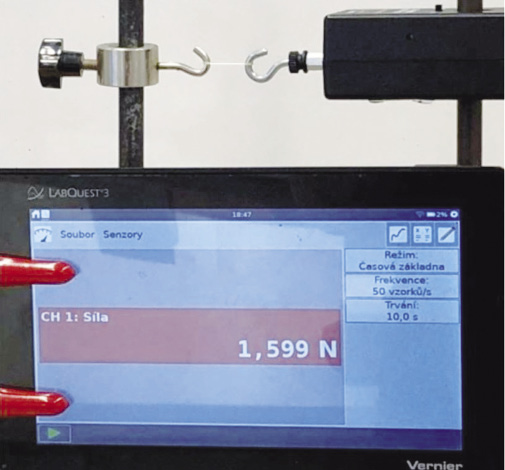
Pět set intermaxilárních elastických elastických tahů bylo měřeno in vitro pětkrát: v časech 0 h, 2 h, 8 h, 24 h a 48 h. K měření jsme měli k an>dispozici elastické tahy od pěti výrobců: Dentaurum® (Dentaurum, Ispringen, Německo), American orthodontics® (American orthodontics Corporate, Sheboygan, WI, USA), 3M (3M®, Monrovia, CA, USA), Ortho organizers® (Ortho Organizers, Carlsbad, CA, USA) a G & H Orthodontics (GH Orthodontics®, Franklin, TN, USA). Od každého výrobce bylo analyzováno sto elastických tahů, z pěti různých balení, kdy každé balení obsahovalo 20 kusů. Celkem bylo provedeno 2500 měření. Všechny elastické tahy byly v rámci data spotřeby, dodané výrobcem dva týdny před měřením, vyrobené nejpozději dva měsíce před měřením. Po obdržení od výrobce byly tahy uloženy v zapečetěných plastových nádobách v tmavém prostředí. Všechny elastické tahy byly podrobeny předběžnému natažení těsně před vlastním měřením – byly nataženy na trojnásobek původního klidového průměru podle doporučení Proffita a Liu [4, 12]. Síla elastických tahů byla měřena jedna po druhé pomocí siloměru od společnosti „ScienceCube“ nastavená na přesnou vzdálenost pro každého výrobce, kalibrovaná před každou sadou měření. Siloměr byl připojen k an>přenosnému dataloggeru „LabQuest3“ od společnosti Vernier (obrázek 1). Měření byla opakována po 2, 8, 24 a 48 h a výsledky byly zaznamenány v newtonech.
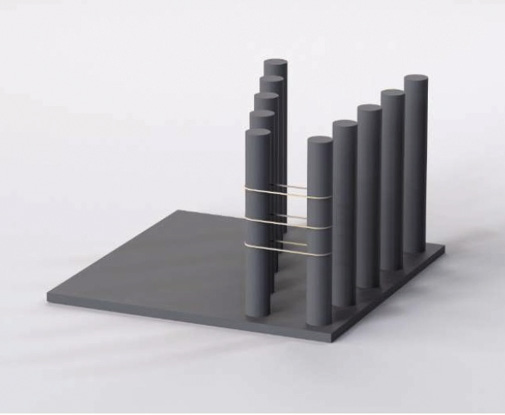
Abychom standardizovali velikost předběžného natažení elastických tahů mezi měřícími intervaly, v programu „Rhinoceros 3D“ byl zhotoven návrh 3D modelu desky s kolíčky, který byl následně vytištěn pomocí tiskárny „Prusa i3 MKS+“. Vzdálenosti mezi kolíčky odpovídaly rozdíly v průměrech elastických tahů od jednotlivých výrobců (obrázek 2). Pokaždé bylo experimentu podrobeno pět elastických tahů od jednoho výrobce. Simulace ústního prostředí v laboratoři byla umožněna pomocí přístroje Ivoclar Inkubátor Vivadent Cultura při konstantní teplotě 37 °C a v řízené vlhkosti prostředí, kde byly mezi měřeními uloženy napnuté elastické tahy. Podmínky v inkubátoru byly průběžně monitorovány pomocí přesného teploměru a senzoru vlhkosti.
Statistická analýza
Shromážděná data byla analyzována Shapiro-Wilkovými testy normality, které ukázaly, že rozložení síly bylo u elastických tahů u většiny výrobců normální. Problém byl pouze u testu normality ve skupině 3M, ve které byly naměřeny extrémní hodnoty. Dále bylo provedeno statistické zpracování pomocí parametrických metod, které byly validizovány pomocí neparametrických testů. Srovnání pěti nezávislých skupin bylo provedeno pomocí analýzy rozptylu (ANOVA) s následnými Bonferroniho post hoc testy. Testy ANOVA vyhodnotily změny sil generovaných ve všech zvolených časech. P-hodnota menší než 0,05 byla považována za statisticky významnou. Pro lepší pochopení výsledků byl proveden převod z newtonů na gramy a unce pomocí následujícího vzorce: 1 N = 101,9716 g;
1 oz = 28,3495 g.
Výsledky
Počáteční síla
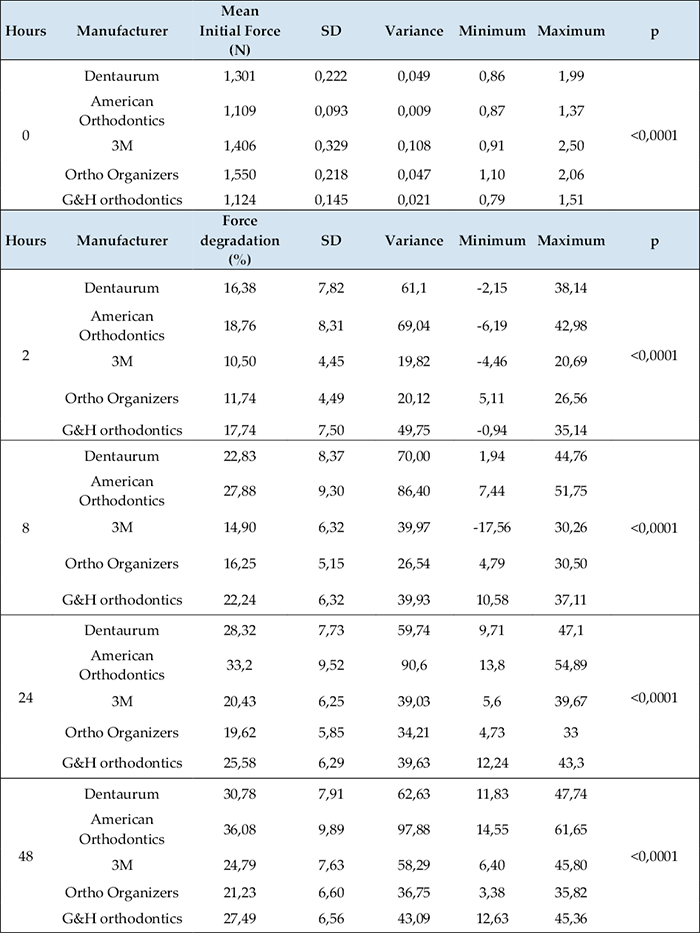
Průměrné hodnoty počáteční síly, stejně jako úroveň síly deklarovaná výrobcem, průměr, délka natažení a kolísání síly jsou uvedeny v tabulce 1. Průměrné hodnoty počáteční síly převedené na gramy a unce jsou uvedeny v tabulkách 2 a 3.
Naměřená počáteční síla elastických tahů se výrazně lišila mezi jednotlivými výrobci (p < 0,001). Síla deklarovaná výrobcem Dentaurum byla 1, 255 N, zatímco počáteční naměřená síla byla 1,301 N. Tyto tahy se nejvíce blížily deklarované hodnotě s rozdílem 0,046 N. Nejvyšší průměrná počáteční síla 1,550 N byla naměřena u výrobce Ortho Organizers, který měl také největší rozdíl 0,299 N mezi deklarovanou silou 1,251 N a naměřenou počáteční silou. Elastické tahy od firmy 3M měly počáteční sílu 1,406 N, zatímco deklarovaná síla byla 1,108 N. Nejnižší síla 1,109 N byla naměřena u tahů firmy American Orthodontics, které spolu s G & H Orthodontics měly deklarovanou sílu větší než naměřenou a záporný rozdíl (–0,146 N a –0,127 N).
Největší rozptyl naměřených hodnot iniciální síly byl zjištěn pro 3M (rozptyl 0,108). Kromě toho se mezi 100 měřenými tahy vyskytly odlehlé i extrémní hodnoty. Rozložení síly u elastických tahů od tohoto výrobce nebylo normální vzhledem k naměřené extrémní hodnotě (obrázek 3). I u dalších výrobců se vyskytovaly odlehlé hodnoty, ale nebyl u nich velký výskyt extrémních hodnot a měly normální distribuci a hodnoty variace byly nižší (American Orthodontics = 0,009; G & H Orthodontics = 0,021; Ortho Organizers = 0,047; Dentaurum = 0,049).
Degradace síly
Degradace síly u intermaxilárních elastických tahů nebyla v průběhu času lineární, přičemž k největšímu poklesu došlo u všech výrobců během prvních dvou hodin (obrázek 3 a 4; tabulky 2 a 3). Hodnoty síly v časech 2, 8, 24 a 48 hodin se výrazně snižují u všech firem, přičemž průměrný pokles je 14,9 %, 20,8 %, 25,43 % a 28,1 %. Ve všech časových periodách rychlost degradace síly byla u jednotlivých výrobců odlišná (p < 0,0001). Největší degradace síly nastala u elastických tahů firmy American Orthodontics: pokles o 18,94 % při 2 h na 81,06 % počáteční síly. Po 8 h se naměřená síla snížila o 27,95 % oproti počáteční síle a pokračovala v poklesu: po 24 h byl pokles o 33,36 % a při 48 h došlo k poklesu o 36,25% počáteční síly. Po 48 hodinách měly elastické tahy z American ortodontics 63,75 % své původní síly, tj. 0,707 N z původních 1,109 N. Nejmenší degradace síly nastala u elastických tahů od firmy 3M po 2 a 8 h; ve 2 hodinách došlo k poklesu o 10,24 % a v 8 h to bylo 15,08 %. Posléze se ovšem tato hodnota zvýšila na 20,41 % a 24,61 % při 24 hodinách a 48 hodinách. Při 24 h a 48 h byla degradace síly nejmenší pro firmu Ortho Organizers, s hodnotami 20 % a 21,61 %, v důsledku toho zbytková síla při 48 h byla největší, a to 78,39 %. Degradace síly pro G & H ortodontics a Dentaurum se pohybovaly někde uprostřed tohoto intervalu a došlo k poklesu na 72,33 % a 68,49 % počáteční síly při 24 hodinách (tabulka 3).
Degradace sil měřených po 2 h byla podobná u elastických tahů od G & H Orthodontics a American Orthodontics (p = 1,00); snížení síly naměřené u ostatních tří společností ve stejném čase periody při 8, 24 a 48 h se výrazně lišily u všech výrobců (p < 0,0001) (tabulka 4).
Diskuse
Výběr intermaxilárního tahu z pohledu klinického lékaře závisí na pohybu zubů či zubních oblouků, kterého chceme dosáhnout, typu použitých aparátů a vzdálenosti míst aplikace tahu, což určuje délku natažení elastického tahu. Výrobci i většina odborné literatury uvádí, že deklarovaná síla tahu je dosažena při natažení tahu na trojnásobek průměru, a tato hodnota předběžného natažení byla použita i v našem experimentu [11] (pravidlo „3“). Nalezneme ale i studie o natažení tahů jenom na dvojnásobek průměru pro dosažení deklarované síly [13, 14]. Jak moc se má intermaxilární tah natáhnout k dosažení deklarované síly bylo předmětem mnoha výzkumů a dosažené síly se mohou lišit podle velikosti a úrovně síly tahů [11, 14, 15]. Gioka a kol. [5] ve své studii měřil vzdálenost natažení tahů pro dosažení deklarované síly. Zjistil, že u 3/16“ (4,8 mm) medium a heavy je to 2,7násobek průměru. U tahů jiných velikostí kolísalo natažení od 2,6 do 5násobku průměru tahu pro dosažení deklarované síly tahu.
Při výběru tahů pro pacienta je potřeba vzít v úvahu, že stejně označené intermaxilární tahy se mezi jednotlivými výrobci odlišují jak v hodnotách uváděné iniciální síly, tak v samotném průměru. Označení síly výrobcem na obalu může být uváděno v g, N, či v uncích (oz), což může vést k nedostatečné informovanosti a zmatení lékaře používajícího jiný metrický systém. Výslednou sílu zaznamenanou na balení tahů lze přepočítat podle vzorce: 1 N = 101,9716 gf (gram force) ≈ 102 g; 1oz (unce)= 28,3495 g = 28,35 cN. U intermaxilárních tahů 3/16“ medium použitých v naší studii byly deklarované iniciální síly u tahů Dentaurum 1,255 N (128 g; 4,5 oz), American orthodontics 1,255 N (128 g; 4,5 oz), G & H orthodontics 1,251 N (127,5 g; 4,5 oz), 3M 1,108 N (113 g; 4,5 oz), Ortho Organizers 1,251 N (127,6 g; 4,5 oz). Rozdíl deklarovaných iniciálních sil u těchto pěti výrobců není větší než 20 g (0,196 N; 0,5 oz). Rovněž průměr intermaxilárních tahů 3/16“ medium se mezi výrobci lišil: Dentaurum je 4.8 mm, 3M 4.6 mm, American Orthodontics 4.8 mm, G & H orthodontics 4.7 mm, Ortho Organizer 4.8 mm. Proto pro přesné dosažení trojnásobku šířky při předběžném natažení v naší studii jsme navrhli a vytiskli přesný 3D model napínací desky, kde pro každého výrobce byly kolíčky pro natažení tahů zhotovené přesně v trojnásobku jím deklarovaného průměru. Porovnání tahů mezi jednotlivými výrobci by tedy mělo být přesnější než u jiných studií, kde všechny tahy byly nataženy na stejnou délku 20–50 mm [7, 9, 11, 16]. Na hodnotu síly iniciálních tahů může mít vliv i stáří a skladování tahů. Všechny tahy, které jsme porovnávali, byly před datem expirace, dodány výrobcem maximálně 2 týdny před měřením, vyrobeny maximálně 2 měsíce před měřením a skladované v tmavých sáčcích na suchém, chladném místě. To proto, abychom předešli chybě měření, pokud by některá šarže měla výrobní problém nebo byla např. zahřátá při dopravě. Bylo měřeno od každého výrobce 20 gumiček a 5 různých výrobních šarží sáčků.
Baty a kol. [17] zjistil možný klinicky významný vliv, pokud je rozdíl mezi naměřenou a deklarovanou silou pomocných zařízení větší než 10 %, nicméně většina studií uvádí, že iniciální síly se od deklarované síly udávané výrobcem liší. Podle Kersey a kol. [9] rozdíly mezi naměřenými a deklarovanými silami se liší od záporných po kladné hodnoty. Další studie tvrdí, že síla tahu je závislá na délce natažení [9, 11, 21, 26]. Podle našich výsledků se u tahů 3/16“ medium nejvíce odlišovala iniciální síla oproti deklarované u tahů firmy Ortho Organizers, kde byla naměřená iniciální síla o 0,299 N větší než deklarovaná. Těsně za ní byly tahy 3M s rozdílem 0,298 N, tyto tahy také vykazovaly největší výkyvy v měřené síle mezi 100 měřenými tahy i do extrémních hodnot. Menší iniciální sílu od deklarované měly tahy firmy American Orthodontics, kde rozdíl byl –0,146 N a G & H Orthodontics s rozdílem –0,127 N. Nejmenší rozdíl mezi iniciální sílou deklarovanou výrobcem a naměřenou průměrnou silou vykazovaly intermaxilární tahy firmy Dentaurum s naměřenou silou 1,301 N a deklarovanou 1,255 N, kde rozdíl byl pouhých 0,046 N. Castroflorio a kol. [10] uvádí rozdíly ve změřené iniciální síle oproti té deklarované pro 3/16“ u tahů několika výrobců, které byly natažené na 16,3 mm. V jeho studii nejmenší rozdíl mezi deklarovanou a naměřenou silou měly pro tah 6,5 oz American Orthodontics, pro tah 2 oz 3M a pro tah 4,5 oz Ormco. Doporučuje, že bez ohledu na značku, je důležité pečlivě vybrat velikost a sílu tahu v závislosti na vzdálenosti míst inzerce tahu než na potřebné síle.
Při používání intermaxilárních tahů pacientem je důležitá nejen jejich iniciální síla, ale i ztráta síly při jejich používání. V průměru jsme u všech pěti výrobců zjistili ztrátu iniciální síly 25 % po 24 hodinách, k největšímu poklesu síly došlo po prvních 2 hodinách v rozsahu 10,2 %–18,9 %, dále byl pokles pozvolnější. I u většiny dalších studií byl největší pokles síly zaznamenán v prvním měřeném intervalu. Největší ztrátu síly mezi 0–2 hodinami nalezl Fernandes a kol. [9], kde pokles síly tahů American Orthodontics 3/16“ při natažení na 30 mm byl během prvních dvou hodin 15,26 %–20,72 %. Castoflorio a kol. [10] změřili pokles za první hodinu 7,92 % u tahů 3M 3/16“ medium natažených na 24.6 mm, Notaroberto a kol. [18] uvádí ve stejném časovém úseku pokles síly dokonce o 14,6 %. Qodcieh a kol. [6] naopak ve výsledcích uvádí vyšší 26,3 ± 8,6 % pokles síly u tahů 3/16“ medium výrobce 3M, při natažení na 24,1 mm. I další výzkumy poukazují na větší ztrátu síly během prvních dvou hodin – mezi 25 %–40 % [9, 12, 14]. Největší pokles síly byl vždy v prvním měřeném intervalu u všech studií. Hwang a Cha [25] ukázali, že po 1 dni byl pokles síly asi 23 %–28 %. Fernandes a kol. [9] zkoumali 3/16“ medium od firmy American Orthodontics natažené na 30 mm, kde z celkového poklesu 21,34 % za 24 hodin byl největší pokles síly po první hodině 15,26 %, posléze 9,98 % mezi 1–3 hodinami, 6,67 % mezi 3–6 hodinami, 7,3 % mezi 6–12 hodinami a 4,53 % mezi 12–24 hodinami. Podobně jako naše studie uvádějí, že s postupem času se degradace síly zpomalila s pokračujícím natahováním po delší dobu [9, 11, 21, 26]. Jednou z mála studií, kde síly byly měřeny kontinuálně, je studie Gioka a kol. [5], kdy autoři neuvádí procento poklesu v prvních hodinách, pouze konstatují, že k největšímu poklesu došlo po 3–5 hodinách. V našem výzkumu byla síla zaznamenávána periodicky po 0, 2, 8, 24 a 48 hodinách v souladu s většinou studií. Kontinuální data sbírána nebyla, nicméně použití nespojitých dat pro konstrukci křivek degradace síly by mohlo vyvolat určitý nevyhnutelný odhad.
Pokles síly v čase se také liší mezi jednotlivými výrobci, stejně jako hodnoty iniciálních sil. Podle výsledků této studie došlo k největšímu procentuálnímu poklesu síly u tahů firmy American Ortodontics, kde po 48 hodinách měl tah 63,75 % iniciální síly, tj. 0,707 N z 1,109 N. Oproti tomu tahy firmy Ortho Organizers, kde iniciální síla byla v průměru 1,550 N, prezentovaly ztrátu síly o 11,7 % po prvních 2 hodinách, 16,2 % po 8 hodinách a 19,2 % a 21,2 % za 24 a 48 hodin. To podporuje zjištění studií [27], kde autoři uvedli, že počáteční síla nemá žádný vztah k množství úbytku síly. Oproti tomu dvě starší studie Wong 1976 a Taloumis a kol. 1995 [28, 29] uvádějí, že čím větší je počáteční síla tahu, tím větší je úbytek síly.
Navzdory širokému použití intermaxilárních tahů v ortodoncii je síla uvolněná během jejich klinické aplikace a degradace síly stále neznámá. V dutině ústní jsou vlastnosti elastických materiálů ovlivňovány fyzikálními, chemickými a biologickými faktory, některé z nich souvisí s funkčními aktivitami, změnami slin a stravovacími návyky, je proto třeba odlišovat výsledky studií in vitro a in vivo [7, 30–32]. Yang a kol. [22] porovnávali degradaci in vivo/in vitro během 48 hodin u velikostí 1/8“, 3/16“,1/4“,5/16“, 3/8“ síly 2 oz a 3,5 oz. Při výzkumu in vivo skupina pacientů nosila fóliové aparáty, kde vzdálenost natažení tahů byla přesně daná, a následovalo porovnání sil těchto tahů, a tahů stejně natažených in vitro v různých laboratorních podmínkách. Průměrná degradace sil pro 1/4“ (2 oz, 3 oz) byla po 48 hodinách in vivo 33,83 % a 36,94 %, při podmínkách in vitro v umělé slině 24,60 % a 26,89 % a při suchých podmínkách měření in vitro 16,44 % a 16,21 %. Z jejich výsledků vyplývá, že degradace sil in vivo je mnohem větší než in vitro. Autoři referují, že k největší degradaci sil došlo během první hodiny, kdy se síla snížila o 13,16 %–18,79 %. Elastické tahy s větším průměrem měly pomalejší degradaci než tahy s menším průměrem (3/8“<5/16“<1/4“<3/16“<1/8“). Qodcieh a kol. [6] zkoumali tahy 3/16“ medium firmy 3M in vivo natažené u pacientů 24,1 ± 4,2 mm s předběžným natažením a zjištěná degradace sil byla 13,4 % za 1 hod, 15,7 % za 3 hodiny, 18,5 % za 6 hod, 19,9 % za 12 hod, 22,2 % za 18 hod, 28,2 % za 24 hod, 30,9 % za 48 hod. 50% síly bylo ztraceno během prvních 3,9 hodin. V naší studii byla degradace sil 3/16“ medium 3M natažených na 13,8 mm 10,24 % po 2 hodinách, 15,8 % za 8 hod, 20 % za 24 hod, 21,61 % za 48 hod, což v porovnání s výše uvedenou in vivo studií je velmi obdobná míra degradace síly in vitro při výrazně menším natažení. Tahy 3/16“ medium 3M natažené na 20 mm za různých podmínek zkoumal i Wang [7]. Zjistil, že k největšímu poklesu síly dochází v první půlhodině. Po 48 hodinách zůstatková síla tahů byla 61 % u tahů in vivo a 71 % in vitro v umělé slině a 86 % in vitro v suché místnosti. V naší in vitro studii byla zůstatková síla 3/16“ medium 3M po 48 hodinách 75,39 %. Ve studii Notaroberto a kol. [18], kteří zkoumali latex and non-latex tahy 3/16“ od American Orthodontics in vivo a natažené na 25 mm tj. s iniciální sílou 225 g, pozoroval největší pokles síly v první hodině 14,6 % pro latexové a 27.32 % pro bezlatexové tahy, a ve třech hodinách o 17 %. Pokles síly latexových tahů 3/16“ za 24 hodin byl v jeho studii o 19,92 %, oproti zde prezentovaným výsledkům, kde byla míra degradace větší než třetina počáteční síly. Provedení výzkumu in vitro je jedním z omezení této studie, které neumožňuje plně reprodukovat klinické stavy, jako je vlastní aplikace a vyjímání tahů před a po ústní hygieně, vliv chemických faktorů z jídel a nápojů atd. a může výrazně ovlivnit výsledky.
Různé názory panují v oblasti toho, jakou iniciální sílu tahů u pacientů zvolit i v oblasti načasování výměny tahů při jejich kontinuálním používání pacienty. Již v roce 1970 Andreasen a Bishara [21] navrhli použít o 40 % větší sílu, než je optimální na začátku aplikace elastického tahu, aby se kompenzovala počáteční ztráta, stejně tak i některé pozdější studie [7, 14]. Pro udržení vysoké síly použitých tahů je některými autory doporučeno měnit tahy po 6 hodinách kvůli degradaci síly [10] u jiných po 12 hodinách [5]. Na druhou stranu Gargurde a kol. [33] navrhli, že elastický tah nemusí pacienti tak často vyměňovat, protože po počáteční degradaci může síla zůstat relativně konstantní po několik dní [7, 20, 21, 33, 34]. Liu a kol. [12] také uvedl, že hodnota síly byla po 1 dni pozoruhodně stabilní, protože strukturální změny způsobené opakovaným natahováním nebyly kumulativní. Hixon a kol. [24] uvádí degradaci 15 % v prvních 3 hodinách, a pak její pokles o 3 % za dalších 8 týdnů, a proto doporučuje výměnu tahů 3x týdně. Bylo však prokázáno, že po více hodinách nošení [7] může docházet k mechanickému poškození tahů, proto je pravidelná výměna tahů nezbytná. Z našich výsledků i většiny dalších studií in vitro či in vivo vyplývá, že tahy ztrácejí po 24 hod v průměru 25 % své síly.
Pro odborníky je nejen důležité dobře znát vlastnosti tahů, ale je také nutné, aby výrobci uváděli vlastnosti silové degradace svých výrobků z důvodu rozdílů pro různé značky tahů [34]. Protože klinicky vzdálenost míst inzerce tahů je u každého pacienta jiná, je vhodné změřit vzdálenost od jednoho bodu zavedení k druhému u každého pacienta a podle toho vybrat velikost tahu. Kliničtí lékaři používající ortodontické elastické prvky potřebují znát velikost síly aplikované na zuby při dané velikosti a natažení tahu, a jak tato síla v průběhu času klesá, aby bylo dosaženo zamýšlených výsledků. Kvůli velké nabídce tahů a rozdílů v označování mezi výrobci by bylo vhodné, aby všechny tahy byly jasně a jednotně označeny. Co se týče průměru, bylo by vhodné ho uvádět v mm a iniciální sílu tahu v N nebo g a případně i degradaci daných tahů v čase.
Závěr
Elastické tahy 3/16“ medium se liší u různých výrobců z hlediska průměru, deklarované a vlastní dosažené iniciální síly při natažení na trojnásobek průměru. Ošetřující lékař si musí být vědom základních parametrů tahů při jejich individuálním výběru pro každého pacienta. Pro nalezení správné velikosti aplikované síly je doporučeno změřit vzdálenost inzerce a sílu tahu siloměrem přímo v ústech. Výsledky 2500 měření in vitro ukázaly, že došlo ke ztrátě přibližně 25 % v síle do 24 h; tyto hodnoty se mezi jednotlivými výrobci odlišovaly.
Elastické tahy měřeny in vitro, které se nejvíce blížily hodnotě počáteční síly deklarované výrobcem byly Dentaurum, zatímco k nejmenší degradaci síly došlo u elastických tahů od výrobce 3M po 2 a 8 hodinách a od Ortho Organizers ve 24 a 48 hpdinách. Pro lepší pochopení vlastností nejpoužívanějších elastických tahů je nutné v budoucích experimentech se zaměřit na analýzu dostatečně velkých vzorků při jasně definovaných podmínkách pro natažení.
Tento článek vznikl za podpory grantu: IGA_LF_2022_008.
Autoři nemají komerční, vlastnické nebo finanční zájmy na produktech nebo společnostech popsaných v tomto článku.
Introduction
Intermaxillary elastics have become an integral part of therapy both in fixed orthodontic appliances, aligners, and in orthognathic management. Appropriate indication together with a good collaboration of a patient may result in shorter and more effective orthodontic treatment. Elastics may be used with orthodontic appliance within one dental arch, between upper and lower dental arches, or they can be attached to extraoral auxiliary appliances [1, 2]. Elastics can be divided to latex and non-latex; they may be also distinguished according to their size and thickness [3]. Manufacturers declare that the required force is achieved when the elastics is stretched to the triple of its diameter [4–6]. To achieve optimum traction and required therapeutic effects an orthodontist should choose appropriate size and thickness of elastic traction.
It is important that each of the applied elastics match the criteria and produce the required force as long as possible while worn by a patient. It is known that elastics are susceptible to force relaxation that gradually decreases due to wear [7, 8]. Therefore, patients are recommended to change elastics every 8 hours, or every 12 or 24 hours. However, the clear instructions for timing of elastics change are still missing.
Previous studies dealing with elastic tractions carefully assessed force degradation in vitro and/or in vivo. However, the studies worked with small samples of elastics, usually tenths of elastic tractions of different manufacturers [5, 7, 9] and worked with elastics of one and the same batch. Thus, due to a relatively small number of elastics from one batch, the results might have been biased.
The most frequent elastics used in clinical practice is latex 3/16“ medium (diameter of 4.8 mm); when stretched to the triple size they should correspond to the force 4.5 oz ≈ 127.6 g (1.3 N). These elastics are also the most realiable from the viewpoint of the acting force related to the force declared and the force loss [10]. Kanchana et al. [11] reported that elastics 3/16“ medium were more homogenous and showed less variability in the sample compared to elastics 3/16“ light and heavy. The article assesses the values of the initial force of 3/16“ medium elastics made by five different manufacturers and of five different batches. We tested force degradation after 2, 8, 24 and 48 hours as well as the character of the decrease.
Material and method
Five hundred intermaxillary elastics were measured in vitro five times: at times 0hr, 2hrs, 8hrs, 24hrs and 48hrs. We tested elastic tractions made by five manufacturers: Dentaurum® (Dentaurum, Ispringen, Germany); American Orthodontics® (American Orthodontics Corporate, Sheboygan, WI, USA); 3M® (3M, Monrovia, CA, USA); OrthoOrganizers® (OrthoOrganizers, Carlsbad, CA, USA), and G & H Orthodontics (GH Orthodontics®, Franklin, TN, USA). We analyzed one hundred elastic tractions from five different batches where each batch comprised 20 pieces. Altogether we carried out 2500 measurements. All the elastics were within the period of their expiry date, supplied by manufacturers two weeks prior the measurements, manufactured two months before the measurement at the latest. After delivery, the elastics were stored in sealed plastic jars in dark. Just before the measurement all the elastic tractions were pre-stretched – stretched to the triple of the original diameter according to Proffit and Liu [4, 12]. Force of elastic tractions was measured with dynamometer of ScienceCube company; it was set to the exact distance for each manufacturer, and prior to each set of measurements it was callibrated. The dynamometer was attached to a portable datalogger LabQuest3 (Vernier) (Fig. 1). Measurements were repeated after 2, 8, 24 and 48 hours, and the results were recorded in newtons.
To standardize the size of preliminary stretching of elastics between two intervals of measurement, using the software Rhinoceros 3D we designed a 3D model of a plate with pegs and then produced it with the printer Prusa i3 MKS+. The distance between the pegs corresponded to differences in diameters of elastics produced by individual manufacturers (Fig. 2). Each time we tested five elastics by one manufacturer. Oral cavity environment was simulated with Ivoclar Incubator Vivadent Cultura at the temperature 37 °C and controlled humidity of the space where the extended elastics were kept between individual measurements. The conditions in the incubator were monitored with a precise thermometer and a humidity sensor.
Statistical analysis
The collected data were analyzed with Shapiro-Wilk normality tests that showed force distribution in elastic tractions normal for most manufacturers. The only problem was with 3M – we found extreme values. We also used parametric methods validated with the help of non-parametric tests. Comparison of five independent groups was performed with analysis of variance (ANOVA) and subsequent Bonferoni’s post hoc tests. ANOVA tests evaluated changes in forces generated at all times, P-value below 0.05 was considered statistically significant. Newtons were converted to grams and ounces using the formula: 1N = 101.9716 g; 1 oz = 28.3495 g.
Results
Initial force
Mean values of initial force as well as of force declared by manufacturer, average, length of stretching and force oscillation are summed up in Table 1. Mean values of initial force converted to grams and ounces are in Table 2 and 3.
Initial force of elastics differs significantly among individual manufacturers (p<0.01). Force declared by Dentaurum was 1.255 N while the actually measured initial force was 1.301 N. These pulls were closest to the declared value with the difference 0.046 N. The greatest average initial force 1.550 N was measured for OrthoOrganizers. However, there was the greatest difference (0.299 N) between the declared force (1.251 N) and the measured initial force. Initial force of 3M elastics was 1.406 N, the declared force was 1.108 N. The lowest force (1.109 N) was recorded in elastics by American Orthodontics. They and G & H Orthodontics gave greater declared force than the force measured and negative difference (–0.146 N and –0.127 N).
The greatest variance of the values measured was found in 3M (variance 0.108). Apart from this there were also found remote and extreme values among the 100 elastics measured. Distribution of force in elastics by this manufacturer was not normal due to the extreme values measured (Fig. 3). Remote values were found in other manufacturers, too. However, there were not so many extreme values, the distribution was normal, and variance lower (American Orthodontics = 0.009; G & H Orthodotics = 0.021; OrthoOrganizers = 0.047; Dentaurum = 0.049).
Force degradation
Force degradation in intermaxillary elastics was not linear; the greatest loss was found in all manufacturers during the first two hours (Fig. 3 and 4; Tables 2 and 3). At times 2,8,24 and 48 the force values decrease significantly in all manufacturers; the average decrease is 14.9%, 20.8%, 25.43% and 28.1%. At all time periods the velocity of force degradation was different in individual manufacturers (p<0.0001). The greatest force degradation was found in elastic tractions by American Orthodontics: drop by 18.94% at 2 hours to 81.06% of the initial force. After 8 hours the force dropped by 27.95% compared to the initial state, and continued to decrease: after 24 hours by 33.36%, after 48 hours by 36.25%. Elastics made by American Orthodontics dropped by 63.75% after 48 hours, i.e. to 0.707 N compared to the initial 1.109 N. The least reduction was recorded for 3M elastic pulls after 2 and 8 hours: after 2 hours the force dropped by 10.24%, and after 8 hours by 15.08%. However, after 24 hours it was by 20.41%, and after 48 hours by 24.61%. Ortho Organizers elastics show the least degradation after 24 and 48 hours – 20% and 21.61% respectively. Therefore, residual force was highest after 48 hours – 78.39%. Force degradation in elastics made by G & H Orthodontics and Dentaurum oscillated at approximately the middle of the interval, after 24 hrs the force decreased to 72.33% and 68.49% of the initial values (Table 3).
Force degradation after 2 hours was similar in elastic pulls made by G & H Orthodontics and by American Orthodontics (p = 1.00); in elastics made by the other manufacturers measured after 8, 24 and 48 hours the force degradation differred significantly (p < 0.0001) (Table 4).
Discussion
From the clinical viewpoint the choice of appropriate intermaxillary traction depends on the desired movement of teeth or dental arches, types of appliances used, and distance between the places of traction applied which is related to the length of elastic pull. Manufacturers as well as literature say that the declared force of traction is achieved when the elastics are stretched to the triple of its diameter – this was applied also in our experimental work [11] (the rule of „3“). However, some authors recommend only double length of the diameter to achieve the declared force [13, 14]. The necessary extension of the intermaxillary traction to achieve the declared force has been subject of a lot of research. Forces achieved may differ in their magnitude and level of elastic pull [11, 14, 15]. Gioka et al. [5] measured stretching of elastic tractions in order to achieve the declared force, and they found that in 3/16“ (4.8 mm) medium and heavy tractions it is 2.7x diameter. In other elastics the value oscillated within the interval 2.6 – 5x.
When deciding about the appropriate elastic traction we should be aware of the fact that intermaxillary elastics labeled identically differ between individual manufacturers in both initial force declared and in diameters. Manufacturer may identify the force in g, N or oz, which can pose a problem for a dentist using a different metric system. The resulting force of pulls can be converted according to the formula: 1 N = 101.9716 gf (gram force) = 102 g; 1 oz = 28.3495 g = 28.35 cN. In intermaxillary elastics used in our work the declared initial forces for individual manufacturers were as follows: Dentaurum 1.255 N (128 g; 4.5 oz), American Orthodontics 1.255 N (128 g; 4.5oz), G & H Oerthodontics 1.251 N (127.5 g; 4.5 oz), 3M 1.108 N (113 g; 4.5 oz), OrthoOrganizers 1.251 N (127.6 g; 4.5 oz). The difference of the declared initial forces does not exceed 20 g (0.196 N; 0.5 oz). The diameter of intermaxillary elastics 3/16“ medium was also different in the five manufacturers: Dentaurum 4.8 mm, 3M 4.6 mm, American Orthodontics 4.8 mm, G & H Orthodontics 4.7 mm, OrthoOrganizer 4.8 mm. To achieve precise triple diameter in preliminary stretching we designed and printed an accurate 3D model of a stretch plate with pegs for each manufacturer corresponding to the triple of the declared diameter. Thus the comparison between individual manufacturers should be more precise than in other studies where the elastics were stretched to the same length 20–50 mm [7, 9, 11, 16]. Initial force may be affected by the age and storage of elastics. All compared elastics were before their expiry date, supplied by manufacturers 2 weeks prior to measurement, produced max. 2 months prior to measurements, and they were kept in dark packets in a dry and cool place. We wanted to avoid error of measurement in case some batch had defect or was e, g, heated during transport. We used 20 elastics and 5 different batches from each manufacturer.
Baty et al. [17] found possible clinically significant effect in case the difference between measured and declared force of auxiliary devices is over 10%. However, most studies report that initial forces differ from the forces declared by manufacturers. According to Kersey et al. [9] the differences range from negative to positive values. Other studies state that traction force depends on the extent of stretching [9, 11, 21, 26]. Our results show that in elastics 3/16“ medium the greatest difference between initial and declared forces was found in OrthoOrganizers – the initial force measured was by 0.299 N bigger than the one declared – followed by 3M elastics in which the difference was 0.298 N. 3M elastics also showed the greatest deviations in the force measured between 100 measured elastics with even extreme values. Lower initial force than declared was found in elastics by American Orthodontics (–0.146 N) and by G & H Orthodontics (–0.127 N). The smallest difference between the initial force declared by manufacturer and the average force actually measured was found in intermaxillary elastics by Dentaurum – the force measured was 1.301 N, the force declared 1.255 N, so that the difference was only 0.046 N. Castroflorio et al. [10] dealt with differences between actually measured initial force and declared force in 3/16“ elastic tractions of several manufacturers. The elastics were stretched to 16.3 mm. The smallest difference for traction 6.5 oz was found in elastics by American Orthodontics, for traction 2 oz 3M, and for traction 4.5 oz Ormco. The authors recommend to carefully choose the extent and force of traction in relation to the distance between the places of insertion. They consider this more important than to decide according to the required force.
When a patient is using intermaxillary elastics the attention should be paid not only to their initial force but to the loss of force during the application. In all five manufacturers we recorded the loss of initial force by 25% after 24 hours when the biggest drop was recorded after first 2 hours – by 10.2%–18.9%, after that the decrease was slower. Most studies report the greatest loss of force during the first interval. Fernandes et al. [9] recorded the greatest degradation of force between 0–2 hours: for American Orthodontics 3/16“ stretched at 30 mm the decrease was by 15.26%–20.72%. Castoflorio et al. [10] recorded the decrease by 7.92% during the first hour in elastics produced 3/16“ medium by 3M stretched to 24.6 mm. Notaroberto et al. [18] gives the loss even by 14.6%. On the contrary, Quodcieh et al.[6] report greater 26.3 ± 8.6% degradation in elastic tractions 3/16“ medium by 3M stretched to 24.1 mm. Other experiments also report greater degradation of force during the first two hours – between 25%–40% [9,12,14]. The greatest loss of force was recorded always within the first interval measured. Hwang and Cha [25] showed degradation of force by approx. 23–28% after 1 day. Fernandes et al. [9] dealt with 3/16“ medium by American Orthodontics stretched to 30 mm. The overall loss was by 21.34% in 24 hours; the greatest drop was recorded after one hour (15.26%), between 1–3 hours by 9.98%, between 3–6 hours by 6.67%, between 6–12 hours by 7.3%, and between 12–24 hours by 4.53%. Similarly with our results the authors say that force degradation slows down with time and with more stretching for a longer period of time [9, 11, 21, 26]. The work by Gioka et al. [5] is one of a few studies in which the forces were measured continually. The authors do not state per cents of the loss during first hours, they only report that the greatest loss was observed after 3–5 hours. In compliance with most works we recorded the force periodically after 0, 2, 8, 24 and 48 hours. Continuous data were not collected, nevertheless the use of discontinuous data to construct curves of force degradation could result in an inevitable estimate.
Degradation of force in time is different among individual manufacturers as well as the initial force values. Our results show the greatest decrease in per cents in elastics by American Orthodontics – after 48 hours the value reached 63.75% of the initial force, i.e. 0.707 N from the original 1.109 N. On the contrary, elastics by OrthoOrganizers with the average initial force of 1.550 N, showed the decrease by 11.7% after 2 hours, 16.2% after 8 hours, 19.2% after 24 hours, and 21.2% after 48 hours. This corresponds to the results of other studies [27] where authors concluded that the initial force is not related to the amount of force degradation. However, two older studies by Wong (1976) and Taloumis et al. (1995) [28, 29] state that the greater the initial force the greater its loss.
In spite of the widespread use of intermaxillary elastic pulls in orthodontic treatment, the force released during the clinical application remains still unknown. In the mouth cavity the characteristics of elastic materials are affected by physical, chemical and biological factors; some are related to functional activities, changes in saliva and eating habits. Therefore, we must make the difference between the results of studies in vitro and in vivo [7, 30–32]. Yang et al. [22] compared degradation in vivo/in vitro within the period of 48 hours of 1/8“, 3/16“,1/4“, 5/16“, 3/8“ of forces 2 oz and 3.5 oz. In vivo group the patients wore folio appliances with accurate stretching of tractions. Then forces of the tractions in vivo were compared with the same tractions in vitro. The average force degradation after 48 hours of 1/4“ (2 oz, 3 oz) was 33.83% and 36.94%; in vitro with artifical saliva 24.60% abd 26.89%, and in dry conditions in vitro 16.44% and 16.21%. The results suggest that in vivo the force degradation is much greater than in vitro. The authors report the greatest force degradation during the first hour (drop by 13.16%–18.79%). Elastic tractions of a bigger diameter showed slower degradation than those with a smaller diameter (3.8“<5/16“<1/4“<3/16“<1/8“). Quodcieh et al. [6] focused on 3M 3/16“ medium elastics in vivo stretched to 24.1 ±4.2 mm with preliminary stretching. The loss of force was 13.4% after 1hr, 15.7% after 3hrs, 18.5% after 6hrs, 19.9% after 12 hrs, 22.2% after 18 hrs, 28.2% after 24 hrs, 30.9% after 48 hrs. During the first 3.9 hrs the loss reached 50%. In our study the force of 3M 3/16“ medium elastics stretched to 13.8 mm decreased by 10.24% after 2hrs, 15.8% after 8hrs, 20% after 24hrs, and 21.61% after 48 hrs. Compared with the in vivo study mentioned before the rate of force degradation in vitro is similar, stretching is significantly smaller. Elastics 3M 3/16“ medium stretched to 20 mm under various conditions were assessed by Wang [7]. He reported the greatest loss of force during the first 30 minutes. After 48 hours the remaining force was 61% in vivo, and 71% in vitro with artificial saliva, and 86% in vitro in a dry space. Our in vitro study found the remaining force of 3M 3/16“ medium 75.39% after 48 hrs. Notaroberto et al. [18] evaluated latex and non-latex elastics 3/16“ made by American Orthodontics in vivo, stretched to 25 mm, i.e. with the initial force of 225 g. They observed the greatest degradation during the first hour – 14.6% in latex and 27.32% in non-latex tractions, and by 17% after 3 hrs. Force degradation of latex elastics 3/16“ after 24 hrs was by 19.92% compared to our results where the degradation extended one third of the initial value. In vitro examination is one of the presented study restrictions as it does not allow to fully reproduce clinical situations, such as adjustment and removal of elastics prior to and after oral hygiene, impact of chemical substances found in food and beverages, etc., which may affect results significantly.
There are different opinions on the choice of the initial force in patients as well as on timing of changing the elastics that are continually used by patients. As early as in 1970, Andreasen and Bishara [21] (and some more recent studies [7, 14]) suggested to apply force greater by 40% than the optimum one at the beginning of elastic traction application in order to compensate for the initial loss. In order to keep great force of tractions, some authors recommend to change the elastics every 6 hrs [10] or 12 hrs [5]. On the other hand, Gargurde et al. [33] state that elastic pull can not be changed so often because after the initial degradation the force may remain relatively constant for several days [7, 20, 21, 33, 34]. Liu et al. [12] noticed that the force becomes remarkably stable after day 1, because structural changes due to repeated stretching were not accumulative. Hixon et al. [24] report degradation by 15% during the first 3 hrs, then it drops by 3% after another 8 weeks. Therefore they recommend to change elastic tractions 3 times a week. However, it was proved that after more hours [7] elastics may be mechanically damaged, and thus the regular exchange of elastics is inevitable. Our results, as well as conclusions of many other studies in vitro/in vivo, show that – on average – elastics lose 25% of force after 24 hrs.
Experts should know the characteristics of elastic tractions, and manufacturers should declare force degradation of their products [34]. Clinically, the distance between places of insertion is different in each patient, therefore, the distance should be measured, and the traction force should be set individually for each patient. In order to achieve the desired outcomes, clinical experts using orthodontic elastics should know the amount of force applied on teeth at a given magnitude and stretching of elastics and force degradation over a period of time. All elastics should be clearly and uniformly labeled; diameter should be given in mm, and initial force in N or g.
Conclusion
Elastics 3/16“ medium made by individual manufacturers differ in diameter, declared and measured initial force achieved when the elastics are stretched to the triple of its diameter. Orthodontists should know the basic parameters of elastics in order to choose the optimum one for each patient. To establish the correct force it is recommended to measure the distance between the points of insertion and the force of traction with a dynamometer intraorally. The results of 2500 measurements performed in vitro showed that force degradation reached approx. 25% after 24 hrs. However, the values were different for different manufacturers.
Elastic tractions measured in vitro closest to the initial force declared by a manufacturer were those made by Dentaurum; the least force degradation was recorded for 3M products after 2 and 8 hrs, and for OrthoOrganizers after 24 and 48 hrs. To better understand the characteristics of the most frequently applied elastic tractions it is necessary to focus on the analysis of sufficiently representative samples under clearly set conditions of stretching.
This article was sponsored by the grant: IGA_LF_2022_008.
Authors have no commercial, proprietary or financial interests in products or companies mentioned in the article.
Obr. 1 / Fig. 1
Elastický tah natažený na přesnou vzdálenost na siloměru „ScienceCube“ připojená k přenosnému dataloggeru „LabQuest3“ / Elastic stretched to the exact distance on the force meter „ScienceCube“ connected to the portable data logger „LabQuest3“
Obr. 2 / Fig. 2
3D model desky s kolíčky / Three-dimensional model of a board with spurs for the standardization of the elastic stretch
Tab. 1 / Tab. 1
Průměrné počáteční síly naměřené pro elastické materiály od pěti výrobců. Průměr a deklarovaná síla daná výrobcem a standardní odchylka, rozptyl, minimální a maximální hodnoty jsou zobrazeny v tabulce. „Přednatažení na 3násobek“ představuje délku elastického natažení / Mean initial forces measured for elastics from five manufacturers. The diameter and declared force given by the manufacturer, and the standard deviation, variance, minimal, and maximal values are displayed in the table. „Stretching 3 times“ represents the length of elastic stretch.
mm = millimeter; N = newton; SD = standard deviation
Tab. 2 / Tab. 2
Průměrná počáteční síla v newtonech a degradace síly v procentech za 0, 2, 8, 24 a 48 hodin / Mean initial forces in newtons and force degradation in percent at 2, 8, 24, and 48 h
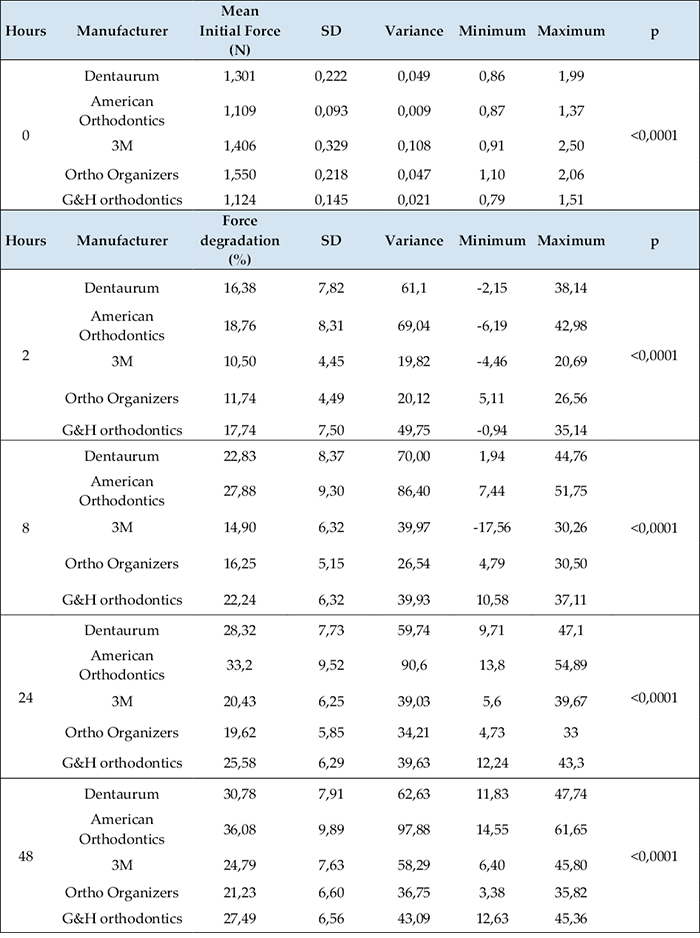
N = newton; SD = standard deviation
Tab. 3 / Tab. 3
Počáteční síla v 0 h - v newtonech, gramech a uncích vypočtené pomocí následujícího vzorce: 1 N = 101,97 gf (gramová síla); 1 unce = 28,35 g. Degradace síly za 2, 8, 24 a 48 h je zobrazena jako procento počáteční síly v newtonech, gramech a uncích. Zbytková síla při 2, 8, 24 a 48 h se zobrazuje v newtonech, gramech a uncích / Initial forces at 0 h in newtons, grams, and ounces calculated using the following formula: 1 N = 101.97 gf (gram force); 1 oz = 28.35 g. Force degradation at 2, 8, 24, and 48 h is shown as a percentage of the initial force, in newtons, grams, and ounces. Residual force at 2, 8, 24, and 48 h is displayed in newtons, grams, and ounces.
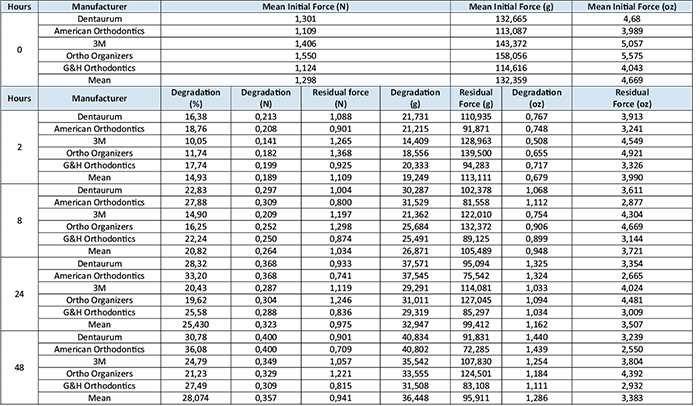
N = newton; g = gram; oz = ounce; Mean = average calculated by dividing the sum of the five values in the set by their number
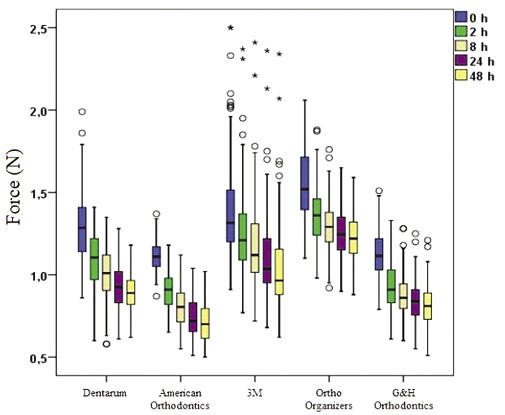
Obr. 3 / Fig. 3
Krabicový graf zobrazující hodnoty mediánu, 1. kvartilu a 3. kvartilu pro všech pět výrobců měřeno ve všech časových obdobích; * = extrémní hodnoty; h = hodiny / Box graph showing median, 1st quartile, and 3rd quartile force values for all five manufacturers measured at all time periods; * = extreme values; h = hours; N = newton
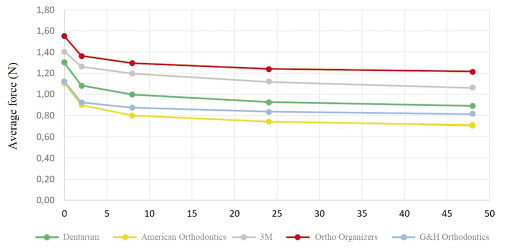
Obr. 4 / Fig. 4
Porovnání poklesu sil všech výrobců v závislosti na časové ose ve všech časech / Graph showing the force decrease in five manufacturers at 0, 2, 8, 24, and 48 h. N = newton
Tab. 4 / Tab. 4
Vícečetné porovnání elastických tahů u všech výrobců v časech 0, 2, 8, 24 a 48 hodin / Multiple comparisons of elastic force among manufacturers at 0, 2, 8, 24, and 48 h
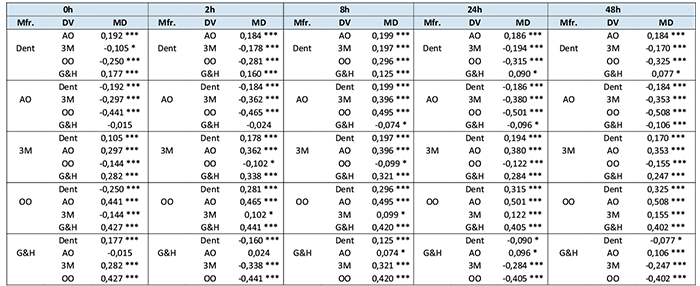
*** = p < 0.0001; * = p ≤ 0.005; Mfr. = manufacturer; DV = dependent variable; MD = mean difference; Dent = Dentaurum; AO = American Orthodontics; OO = Ortho Organizers;
G&H = G&H Orthodontics.

Literatura / References
1. Topouzelis N, Palaska, KP. A review of the clinical applications of elastic tractions in orthodontics. World J. Orthodont. 2009;10(1):12–8.
2. Thurzo A, Urbanová W, Novák B, Waczulíková I, Varga I. Utilization of a 3D Printed Orthodontic Distalizer for Tooth-Borne Hybrid Treatment in Class II Unilateral Malocclusions. Materials. 2022;15:1740. doi: 10.3390/ma15051740
3. Singh V, Pokharel P, Pariekh K, Roy D, Singla A, Biswas K. Elastics in orthodontics: a review. Health Renaissance. 2012;10(1):49–56. doi: 10.3126/hren.v10i1.6008
4. Proffit WR, Fields HW, Sarver DM. Contemporary orthodontics. 4th ed. St. Louis: Mosby; 2007.
5. Gioka C, Zinelis S, Eliades T, Eliades G. Orthodontic latex elastics: a force relaxation study. Angle Orthodont. 2006;76(3):475–9.
6. Qodcieh SM, Al-Khateeb SN, Jaradat ZW, Abu Alhaija ES. Force degradation of orthodontic latex elastics: An in-vivo study. Amer. J. Orthodont. dentofacial Orthop. 2017;151(3):507–512. doi: 10.1016/j.ajodo.2016.08.023
7. Wang T, Zhou G, Tan X, Dong Y. Evaluation of force degradation characteristics of orthodontic latex elastics in vitro and in vivo. Angle Orthodont. 2007;77(4):688–93. doi: 10.2319/022306-76
8. Klabunde R, Grünheid T. Dynamic force decay evaluation of latex and non-latex orthodontic elastics. J. Orofac. Orthop./Fortschr. Kieferorthopädie. 2022;83:318–324. doi: 10.1007/s00056-021-00319-w
9. Fernandes DJ, Fernandes GM, Artese F, Elias CN, Mendes AM. Force extension relaxation of medium force orthodontic latex elastics. Angle Orthodont. 2011;81(5):812–9. doi: /10.2319/120810-709.1
10. Castroflorio T, Sedran A, Spadaro F, Rossini G, Cugliari G, Quinzi V et al. Analysis of Class II Intermaxillary Elastics Applied Forces: An in-vitro Study. Front. Dent. Med. 2022; 2:748985. doi: 10.3389/fdmed.2021.748985
11. Kanchana P, Godfrey K. Calibration of force extension and force degradation characteristics of orthodontic latex elastics. Amer. J. Orthodont. dentofacial Orthop. 2000;118(3):280–7. doi: 10.1067/mod.2000.104493
12. Liu CC, Wataha JC, Craig RG. The effect of repeated stretching on the force decay and compliance of vulcanized cis-polyisoprene orthodontic elastics. Dent. Mater. 1993;9(1):37–40. doi: 10.1016/0109-5641(93)90103-W
13. Oesterle LJ, Owens JM, Newman SM, Shellhart WC. Perceived vs measured forces of interarch elastics. Amer. J. Orthodont. dentofacial Orthop. 2012;141(3):298–306. doi: 10.1016/j.ajodo.2011.08.027
14. Kersey ML, Glover KE, Heo G, Raboud D, Major PW. A comparison of dynamic and static testing of latex and nonlatex orthodontic elastics. Angle Orthodont. 2003;73(2):181–6.
15. Russell KA, Milne AD, Khanna RA, Lee JM. In vitro assessment of the mechanical properties of latex and non-latex orthodontic elastics. Amer. J. Orthodont. dentofacial Orthop. 2001;120(1):36–44. doi: 10.1067/mod.2001.114642
16. Sauget PS, Stewart KT, Katona TR. The effect of pH levels on nonlatex vs latex interarch elastics. Angle Orthodont. 2011;81(6):1070–4. doi: 10.2319/011811-34.1
17. Baty DL, Volz JE, von Fraunhofer JA. Force delivery properties of colored elastomeric modules. Amer. J. Orthodont. dentofacial Orthop. 1994;106(1):40–6. doi: 10.1016/S0889-5406(94)70019-2
18. Notaroberto DFC, Martins MME, Goldner MTA, Mendes AM, Quintão CCA. Force decay evaluation of latex and non-latex orthodontic intraoral elastics: in vivo study. Dent. Press J. Orthodont. 2018;23(6):42–47. doi: 10.1590/2177-6709.23.6.042-047.oar
19. López Ronquillo NM. Estudio in vitro de la pérdida de fuerza experimentada por los elásticos de ortodoncia con látex y libres de látex. Universidad de Murcia. 2016.
20. Nitrini ATL, Chagas AS, Freitas KMS, Valarelli FP, Cançado RH, de Oliveira RCG, de Oliveira RCG. Comparison of the Force Released by Intermaxillary Elastics Used for Different Time Periods. Turk. J. Orthodont. 2019;32(4):190–4. doi: 10.5152/TurkJOrthod.2019.18022
21. Andreasen GF, Bishara S. Comparison of alastik chains with elastics involved with intra-arch molar to molar forces. Angle Orthodont. 1970;40(3):151–8.
22. Yang L, Lv C, Yan F, Feng J. Force degradation of orthodontic latex elastics analyzed in vivo and in vitro. Amer. J. Orthodont. dentofacial Orthop. 2020;157(3):313–19. doi: 10.1016/j.ajodo.2019.03.028
23. Jastrzebski ZD. Nature and Properties of Engineering Materials. Wiley and Sons. New York, USA, 1976.
24. Hixon EH, Aasen TO, Clark RA, Klosterman R, Miller SS, Odom WM. On force and tooth movement. Amer. J. Orthodont. 1970;57(5):476–8. doi: 10.1016/0002-9416(70)90166-1
25. Hwang CJ, Cha JY. Mechanical and biological comparison of latex and silicone rubber bands. Amer. J. Orthodont. dentofacial Orthop. 2003;124(4):379–86. doi: 10.1016/S0889-5406(03)00564-X
26. Bishara SE, Andreasen GF. A comparison of time related forces between plastic alastiks and latex elastics. Angle Orthodont. 1970;40(4):319–28.
27. Hershey HG, Reynolds WG. The plastic module as an orthodontic tooth-moving mechanism. Amer. J. Orthodont. 1975;67(5):
554–62. doi: 10.1016/0002-9416(75)90300-0
28. Wong AK. Orthodontic elastic materials. Angle Orthod. 1976;46(2):196–205.
29. Taloumis L, Moles JA, Hopkins R. Instructions for wearing elastics. J. clin. Orthodont. 1995;29(1):49.
30. De Genova DC, McInnes-Ledoux P, Weinberg R, Shaye R. Force degradation of orthodontic elastomeric chains--a product comparison study. Amer. J. Orthodont. 1985;87(5):377–84. doi: 10.1016/0002-9416(85)90197-6
31. Meto A, Colombari B, Odorici A, Giva LB, Pericolini E, Regina AL, Blasi E. Antibacterial Effects of MicroRepair®BIOMA-Based Toothpaste and Chewing Gum on Orthodontic Elastics Contaminated In Vitro with Saliva from Healthy Donors: A Pilot Study. Appl. Sci. 2020; 10(19):6721. doi: 10.3390/app10196721
32. Leão Filho JC, Gallo DB, Santana RM, Guariza-Filho O, Camargo ES, Tanaka OM. Influence of different beverages on the force degradation of intermaxillary elastics: an in vitro study. J. Appl. Oral Sci. 2013;21(2):145–9. doi: 10.1590/1678-7757201302256
33. Gangurde PV, Hazarey PV, Vadgaonkar VD. A study of force extension and force degradation of orthodontic latex elastics: An in vitro study. APOS Trends Orthodont. 2013;3:184–9. doi: 10.4103/2321-1407.121438
34. Beattie S, Monaghan P. An in vitro study simulating effects of daily diet and patient elastic band change compliance on orthodontic latex elastics. Angle Orthodont. 2004;74(2):234–9.
MDDr. Barbora Ličková
Klinika zubního lékařství FNOL a UPOL
Palackého 12, 772 00 Olomouc