Skeletální efekt funkčního aparátu SUS2 u rostoucích pacientů s II. třídou
Skeletal effects of treatment for Class II malocclusion with functional appliance SUS2 in growing patients


MDDr. Alžbeta Omastová, Ph.D., doc. MUDr. Pavlína Černochová, Ph.D.
Stomatologická klinika, Lékařská fakulta Masarykovy univerzity a Fakultní nemocnice u sv. Anny, Brno / Department of Stomatology, Faculty of Medicine, Masaryk University and St.Anne’s University Hospital Brno
DOI10.61110/50329
Souhrn
Cíl: Cílem této retrospektivní kefalometrické studie je posoudit skeletální efekt fixního funkčního aparátu Sabbagh Universal Spring druhé generace (SUS2) u pacientů s II. skeletální adentální třídou v období růstového spurtu.
Materiál a metodika: edovaný soubor byl tvořen 90 pacienty s II. skeletální a dentální třídou, kteří byli rozděleni do 3 skupin podle způsobu léčby: 1. pomocí fixního aparátu a SUS2, 2. pomocí fixního aparátu a elastických tahů II třídy a 3. neléčená kontrolní skupina. Kefalometrický snímek byl zhotoven v období před růstovým spurtem (T1) a v období po růstovém spurtu (T2) a léčba probíhala v období CVMS 3 a CVMS 4. Skeletální efekt léčby byl zkoumán měřením délkových a úhlových parametrů na bočních kefalometrických snímcích a provedením statistické analýzy.
Výsledky: V průběhu léčby aparátem SUS2 došlo ke statisticky významnému zmenšení úhlu ANB o 2,06°. Tato změna byla způsobena zvětšením úhlu SNB o 0,94° a zmenšením úhlu SNA o 1,46°. Oproti tomu ve skupině s tahy II. třídy a v kontrolní skupině byly změny statisticky nevýznamné.
Závěr: Použitím aparátu SUS2 v období pubertálního růstového spurtu dochází k malým skeletálním změnám, které jsou statisticky významné, nicméně jejich klinický význam je spíše zanedbatelný. Z pohledu dentálních změn je aparát SUS2 účinnou alternativou tahů II. třídy, vhodnou zejména u nespolupracujících pacientů.
(Ortodoncie 2025, 34, č. 1, s. 29–40)
Abstract
Aim: The retrospective cephalometric study assesses skeletal effect of fixed appliance Sabbagh Universal Spring of the second generation (SUS2) in patients with skeletal and dental class II during the growth spurt.
Material and method: The sample included 90 patients with skeletal and dental class II divided into 3 groups based on the therapy: 1.fixed appliance and SUS2; 2. fixed appliance and class II elastics; 3. control group (no therapy). Cephalograms were taken prior to growth spurt (T1) and after completed growth (T2), therapy took place within the periods CVMS 3 and CVMS 4. Skeletal effects were assessed with measurements of linear and angular parameters in lateral cephalograms followed by statistical analysis.
Results: During therapy with SUS2 angle ANB significantly decreased by 2.06°. The change was due to increased angle SNB by 0.94°and decreased angle SNA by 1.46°. In the group with class II elastics as well as in the control group the changes were statistically insignificant.
Conclusion: SUS2 treatment during growth spurt leads to minor skeletal changes that are statistically significant, however, the clinical results are rather negligible. SUS2 appliance is an effective alternative to class II elastics and it is used in low compliance patients.
(Ortodoncie 2025, 34, No. 1, p. 29–40)

Klíčová slova: fixní funkční aparát, anomálie II. třídy, aparát SUS2, kefalometrická studie.
Key words: fixed functional appliance, class II malocclusions, SUS2 appliance, cephalometric study.
Úvod
Ortodontické anomálie II. třídy jsou nejčastějšími typy malokluze, a to jak dentální, tak skeletální. V Evropě se vyskytují u 33,51 % jedinců ve stálém chrupu a ve smíšeném chrupu u 31.95 % [1]. Častým faktorem přispívajícím k vývoji těchto anomálií je redukovaná velikost dolní čelisti. Menší míru výskytu lze připsat anteriorní poloze horní čelisti nebo diskrepanci poloh obou čelistí [2, 3]. Tento jev představuje běžný klinický problém, což vedlo k vývoji řady léčebných postupů, jako jsou růstová modifikace, kamuflážní léčba a chirurgická korekce sagitálního vztahu čelistí. V případech nedostatečného růstu dolní čelisti lze její růst stimulovat během fáze růstového spurtu pomocí funkčních aparátů. Tyto aparáty podporují anteriorní růst dolní čelisti a přizpůsobují polohu temporomandibulárního kloubu za kontroly výšky dolní části obličeje a upravují polohu zubních oblouků. V případě časného stálého chrupu lze uplatnit jednofázovou léčbu pomocí fixních funkčních aparátů, kde je možné kombinovat fixní aparát spolu s funkčním aparátem.
Hlavní předností fixních funkčních aparátů je jejich nezávislost na spolupráci pacienta. Tyto aparáty jsou označované v zahraniční literatuře jako „non-compliance Class II correctors“ a nabízí v kombinaci s fixními aparáty možnost zkrácení léčby. Na trhu je k dispozici široké spektrum fixních funkčních aparátů, včetně modelů jako Forsus, Sabbagh Universal Spring2 (SUS2), Jasper Jumper, Twin Force Bite Corrector, MARA, Flex Developer, Herbst atd. Většinu těchto aparátů je možné aplikovat při jediné návštěvě pacienta, a to po instalaci ocelových oblouků fixních aparátů. Výrobci těchto systémů slibují jak dentální, tak skeletální účinky pro korekci II třídy. Signifikantně nejvýznamnější skeletální efekt je prokázán u aparátu Herbst
Aparát Herbst, představený v roce 1905 německým ortodontistou Emilem Herbstem, představuje první skutečně efektivní a sofistikovaný fixní funkční aparát určený ke korekci anomálií II. třídy. Jeho širší klinické uplatnění umožnil Hans Pancherz koncem 70. let 20. století. Rozsáhlé výzkumy nejen potvrdily jeho dentální efekt v úpravě II. třídy, ale především zdůraznily jeho významné skeletální účinky [4, 5]. Výsledky léčby se zdají být dlouhodobě stabilní [6]. Správné načasování fixní funkční léčby je klíčovým faktorem pro dosažení optimálních výsledků léčby. Podle autorů Ruf a Pancherz [7, 8] je ideální období pro použití Herbstova aparátu v stálém chrupu, konkrétně v době nebo těsně po vrcholu pubertálního růstu. Tento časový rámec odpovídá skeletálním stupňům zralosti FG až H u dolního špičáku. Během tohoto období dochází k největšímu růstu dolní čelisti, což přispívá k dlouhodobé stabilitě výsledků léčby. Typická doba použití Herbstova aparátu je přibližně 6 až 12 měsíců [8], v závislosti na individuálních potřebách pacienta a cílech léčby. Tento přístup byl prokázán jako účinný při dosahování významných dentoskeletálních změn a zlepšování profilu obličeje u mladých dospělých. Výroba tohoto aparátu je však složitá a zahrnuje laboratorní fázi. Z tohoto důvodu se výrobci snaží vyvinout aparát s podobnými účinky, který by umožňoval jednoduchou a jednokrokovou aplikaci přímo v ordinaci.
Takový aparát by mohl být SUS, jehož autorem je Dr. Aladin Sabbagh. Tento aparát, nyní ve své třetí generaci, obsahuje řadu inovací zaměřených na zvýšení pohodlí pacienta a usnadnění jeho aplikace. Jeho klíčovým prvkem je pružinový mechanismus, který umožňuje dynamický pohyb dolní čelisti a zároveň snižuje riziko poškození aparátu a potřebu jeho častých úprav. Díky možnosti deaktivace vnitřní pružiny teleskopu lze zvýšit rigiditu aparátu, čímž se jeho účinky stávají srovnatelnými s Herbstovým aparátem dle informací výrobce. Tyto vlastnosti by mohly aparát SUS učinit plnohodnotnou náhradou Herbstova aparátu, pokud by byly prokázány jeho srovnatelné skeletální účinky. Avšak současné zdroje týkající se skeletálního efektu SUS u rostoucích jedinců jsou značně omezené [9, 10]. V literatuře se také zmiňuje případ jeho jednostranného využití, což je považováno za značně kontroverzní [11].
Cílem této studie je zhodnotit skeletální účinky druhé generace aparátu SUS, tzv. SUS2 ve srovnání se skupinou s tahy II. třídy a kontrolní skupinou. Byla formulována nulová hypotéza, že mezi jednotlivými skupinami nedochází k rozdílům ve skeletálních parametrech.
Materiál a metodika
Velikost vzorku byla stanovena pomocí softwaru G*Power [12] pro párový t-test. Pro určení velikosti účinku byla využita data z předchozí studie týkající se úhlu ANB [9], kde tato míra síly jevu byla 0,931. Pro dosažení statistické síly 0,95 a alfa úrovně 0,05 bylo potřeba minimálně 14 pacientů v jedné léčebné skupině.
Studie byla schválena Etickou komisí Fakultní nemocnice u sv. Anny v Brně a následně bylo do studie zařazeno 90 pacientů, kteří byli rozděleni do 3 skupin po 30 pacientech: první skupina byla léčena pomocí aparátu SUS2, druhá skupina léčena pomocí tahů II. třídy a třetí byla kontrolní neléčená skupina.
Léčené skupiny byly tvořeny pacienty Ortodontického oddělení Stomatologické kliniky FN u sv. Anny v Brně a LF MU a soukromé ordinace MUDr. Zdeňka Hofmana v Hradci Králové. Výběrovými kritérii pro léčené skupiny byly:
• II. Angleova anebo 1/2 II. Angleova třída v molárech, 1. nebo 2. oddělení před léčbou;
• skeletální II. třída před léčbou,
• dosažení okluze v I. Angleově třídě po léčbě,
• stadium maturace obratlů CVMS II–III v čase T1, v čase T2 CVMS IV–V.
Vyřazovací kritéria zahrnovala:
• nekompletní dokumentaci,
• syndromové onemocnění nebo kraniofaciální anomálie,
• předčasné ukončení léčby a nedosažení okluze v I. třídě.
V obou léčených skupinách byl použit fixní aparát s velikostí drážky zámků 0,018“, nebo kombinovaná technika zámků s 0,018“ drážkou na řezácích a 0,022“ na ostatních zubech. Po nivelizaci horního a dolního zubního oblouku byly použity ocelové oblouky velikosti minimálně 0,016 × 0,025“ a nasazen aparát SUS2 s deaktivovanou vnitřní pružinou anebo tahy II. třídy. Ukončení léčby následovalo až po dosažení artikulace v I. Angleově třídě. Hodnoceny byly kefalometrické snímky zhotovené v čase T1 (před začátkem léčby fixním aparátem) a v čase T2 (po ukončení léčby fixním aparátem).
Kontrolní skupina byla vytvořena s využitím růstových studií zveřejněných Americkou Asociací Ortodontistů [13]. Záznamy o subjektech byly získány ze studií Bolton-Brush, Denver, Forsynth Twin a Oregon. Vybrány byly subjekty s II. třídou.
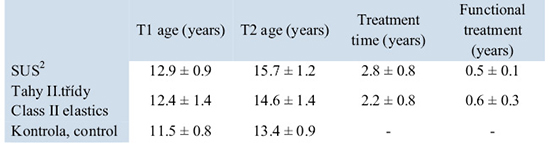
Věk a doba léčby v jednotlivých skupinách jsou shrnuty v Tab. 1. Všechny subjekty byly sledovány v období růstového spurtu, který byl ověřen pomocí stádia maturace obratlů dle metody Baccetti a kol. [14].
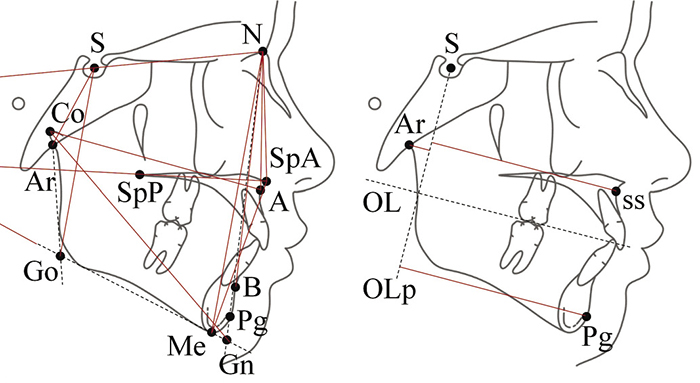
Kefalometrické snímky byly analyzovány jedním hodnotitelem v programu Ortík (Verze 2. 2. 9, Orthosoft, s. r. o., Valtice, Česká republika). Měřeny byly standardní kefalometrické skeletální parametry a vybrané vzdálenosti z Pancherzovy analýzy [15], viz Obr. 1 a Tab. 2. Pro měření parametrů Pancherzovy analýzy byla na kefalometrickém snímku v čase T1 stanovena okluzní linie (OL) s kolmicí (OLp) probíhající v bodě S (střed tureckého sedla). Tato kolmice byla přenesena na kefalometrický snímek v čase T2 pomocí referenční linie S-N (sella-nasion) a linie OLp protínala bod S.
S odstupem 2 týdnů bylo provedeno opakované měření náhodně vybraných deseti snímků pro zjištění chyby měření, určené pomocí Dahlbergova vzorce. Všechny parametry vykazovaly chybu měření v rozsahu 0,15 % až 2,96 %, přičemž statistická analýza neprokázala významný rozdíl mezi prvním a druhým měřením.
Statistická analýza byla provedena v programu Microsoft Excel, verze Microsoft 365 (Microsoft Corporation, Redmond, USA). S využitím metod popisné statistiky byly pro jednotlivé skupiny hodnoceny parametry v čase T1 a T2 a jejich rozdíl T2–T1. Normální rozložení dat jednotlivých souborů bylo ověřeno pomocí Shapiro-Wilkova testu. Na začátku byla použita jednovýběrová ANOVA pro posouzení shody výsledků mezi skupinami v čase T1. Bylo zjištěno, že rozdíly nejsou statisticky významné, a tedy výchozí stav lze považovat za srovnatelný. Statistická významnost změn mezi časem T1 a T2 pro jednotlivé skupiny byla posouzena pomocí párového t-testu. Před porovnáním rozdílů mezi skupinami parametrů T2–T1 byl proveden F-test pro určení shody rozptylů porovnávaných datových souborů. V případě, že byly rozptyly vyhodnoceny jako shodné, byla dále použita jednovýběrová ANOVA a Tukey-Kramerův test pro stanovení významně rozdílných skupin. Pokud byly rozptyly různé, byl použit dvouvýběrový t-test s nerovností rozptylů.
Výsledky
Délka léčby
Parametry průměrného věku a délky léčby jsou shrnuty v Tab. 1. Výchozí stav, tedy věk subjektů v čase T1 při zahájení léčby se významně nelišil (SUS2 vs. tahy II.třídy, p = 0,16; SUS2 vs. kontrola, p = 0,54; tahy II.třídy vs. kontrola, p = 0,96). Dentální korekce distookluze do vztahu I. Angleovy třídy bylo dosaženo u SUS2 za 0,5 ± 0,1 roku a ve skupině s tahy II. třídy za 0,6 ± 0,3 roku. Porovnání délky léčby rovněž nevykazovalo statisticky významný rozdíl (SUS2 vs. tahy II. třídy, p = 0,11).
Sagitální parametry
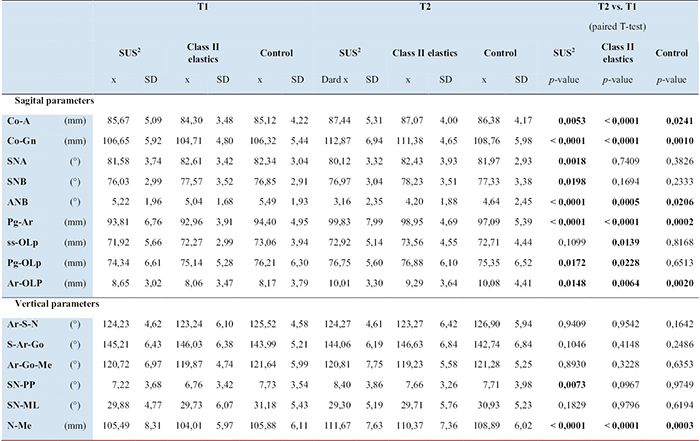
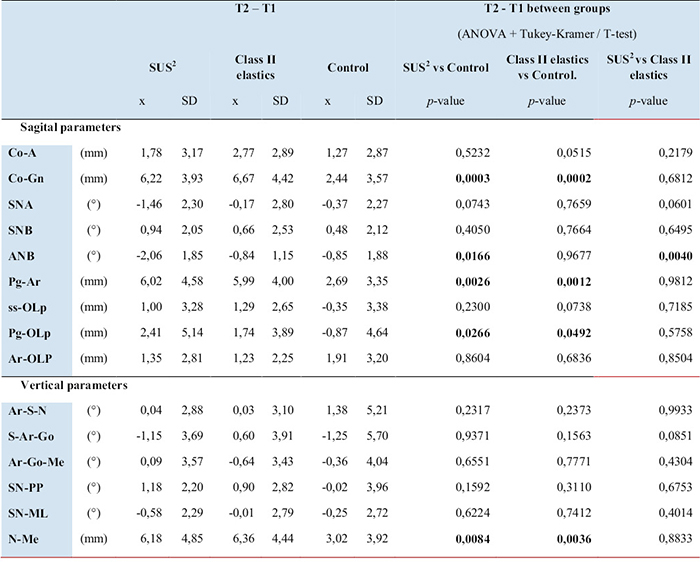
Výsledné hodnoty parametrů v čase T1 a T2 shrnuje Tab. 2, rozdíl v časech T2–T1 je uveden v Tab. 3. Pro posouzení možného skeletálního efektu je nejdůležitější vzájemné postavení čelistí definované úhlem ANB, resp. postavení horní a dolní čelisti vůči přední bazi lební (SNA a SNB). Ke statisticky významnému zmenšení úhlu ANB došlo ve všech skupinách. K jeho zmenšení došlo díky repozici bodů A a B vůči přední bazi lební, přičemž nastalo zmenšení úhlu SNA a mírný nárůst úhlu SNB. Tato změna však byla statisticky významně větší u skupiny s SUS2 (–2,06 ± 1,85°) než u skupiny s tahy (–0,84 ± 1,15°) a kontrolní skupiny (–0,85 ± 1,88°). To je dáno změnou úhlů SNA a SNB, která byla mezi časy T2 a T1 statisticky významná jen u skupiny SUS2.
U parametrů definujících délku mandibuly (vzdálenosti Co-Gn a Pg-Ar) došlo k výraznému růstu u všech skupin. Významně větší byl růst parametru Co-Gn u skupiny s SUS2 (6,22 ± 3,93 mm) a s tahy II.třídy (6,67 ± 4,42 mm) vůči kontrolní skupině (2,44 ± 3,57 mm). Podobný trend byl pozorován rovněž u parametru Pg-Ar.
Z pohledu parametrů Pancherzovy analýzy nastal nárůst vzdálenosti Co-OLp u kontrolní skupiny, zatímco významné zvětšení délky Pg-OLp jen u skupiny SUS2. Změna délky ss-OLp nebyla průkazná.
Vertikální parametry
Ve vertikální rovině došlo u všech skupin ke statisticky významnému růstu délkových parametrů (N-Me, S-Go, N-SpA, SpA-Me). Statisticky větší byl pak růst parametrů N-Me a S-Go u léčených skupin vůči kontrolní skupině. Změny úhlů ve vertikální rovině nebyly až na výjimku (SN-PP u SUS2) statisticky významné. U skupiny SUS2 a také tahů II.třídy vůči kontrolní skupině došlo k zvýšení přední a zadní obličejové výšky.
Diskuse
Pacienti zapojení do studie byli vybíráni retrospektivně a měli skeletální a dentální II. třídu. Léčba byla zahájena krátce před vrcholem růstového spurtu, který byl určen na základě zralosti obratlů. Studie měla za cíl zjistit, zda aplikace ortodontické síly během vrcholu růstového spurtu stimuluje růst čelistí a vede k příznivým skeletálním změnám.
Vertikální parametry
Úhlové vertikální parametry se funkční léčbou téměř nezměnily, což odpovídá výsledkům obdobných studií [8, 9, 16]. Na základě těchto zjištění lze konstatovat, že používání fixních funkčních aparátů je bezpečné i pro subjekty, kde by zvýšení dolní obličejové třetiny působilo značně neesteticky. Vertikální kontrola je zachována.
Ve skupině lineárních vertikálních parametrů došlo v obou léčených skupinách k podobnému zvětšení přední a zadní obličejové výšky (N-Me a S-Go), a to statisticky významně vůči kontrolní skupině. Tato změna byla symetrická a neměla vliv na zvětšení úhlových vertikálních parametrů. Funkční léčba pravděpodobně způsobuje změnu polohy kondylu v kloubní jamce, což spolu s růstem kondylu může vysvětlovat uvedené změny. Významný růst kondylu ve vertikálním směru v růstovém spurtu při použití aparátu Herbst byl prokázán Pancherzem a Häggem [24]. Změny střední a dolní obličejové třetiny (N-SpA a SpA-Me) lze připsat převážně přirozenému růstu. Stimulace funkční léčbou je klinicky zanedbatelná.
Sagitální změny
Fixní funkční aparát SUS2 umožnil upravit II. třídu s minimálním vlivem na skelet, což znamená, že korekce byla z velké části založena na dentálních změnách. I když došlo k určitému statisticky významnému zlepšení v úhlech SNA a SNB, tyto změny byly malé a variabilita mezi pacienty byla značná, takže tento trend nebyl konzistentně pozorován u všech hodnocených pacientů. Obdobné výsledky publikoval Hemmatpour et al. [9], kde byl aplikován SUS2 aparát u pacientů s 1. a 2. oddělením II. třídy. Korekce anomálie byla dána převážně dentálními změnami a aparát byl stejně efektivní u úpravy obou oddělení.
Studie Oztoprak et al. [16], která srovnávala účinky aparátů SUS2 a Forsus na korekci třídy II, přinesla podobné výsledky. Její autoři zjistili, že oba aparáty účinně korigují II třídu tím, že indukují příznivé změny v sagitálním směru. Klíčovým zjištěním bylo, že ačkoli oba aparáty jsou účinné, SUS2 má tendenci vyvolávat větší skeletální změny a průměrné zlepšení úhlu ANB bylo o 1° větší, což ale nemá klinický význam.
Ve všech skupinách bylo pozorováno zlepšení v hodnotách Co-A, což souvisí nejspíš s přirozeným růstem jednotlivců. Parametry Co-Gn a Pg-Ar ukázaly mírně lepší výsledky ve skupině s aparátem SUS2. V obdobné studii Jayachandrana a kol. [17] s aparátem AdvanSync a s tahy II. třídy nebyl pozorován významný rozdíl mezi léčenými skupinami a kontrolní skupinou. V tomto případě však nastalo podstatné zvětšení vzdálenosti Co-Gn i u kontrolní skupiny. Nárůst vzdálenosti Pg-Ar byl způsoben anteriorní repozicí mandibuly nebo dorzální a kraniální repozicí bodu Ar během léčby, jak uvádí Chen a kol. [18]. Zvětšení této vzdálenosti při použití aparátu SUS2 pozoroval rovněž Hanandeh a kol. [10] a mimo růstový spurt Nalbantgil [19]. V těchto referencích byla změna hodnocena pouze v období použití funkčního aparátu a byla tedy podstatně menší.
U skeletálních parametrů Pancherzovy analýzy lze vzhledem k předpokládané funkci aparátu SUS2 očekávat zmenšení vzdálenosti ss-OLp. To však výsledky této práce nepotvrdily. Je známo, že v průběhu léčby funkčními aparáty dochází k rotaci okluzní roviny ve směru hodinových ručiček, což spolu s kaudální repozicí bodu A může mít vliv na výsledek. Nevýznamnou změnu této vzdálenosti pozoroval i Hannandeh a kol. [10], případně Pancherz a kol. s aparátem Herbst [15]. Zvětšení parametru Pg-OLp u skupiny SUS2 koresponduje s prodloužením vzdálenosti Pg-Ar, pravděpodobně díky anteriornímu posunu bodu Pg. Výsledky Pancherzovy analýzy byly značně lepší ve studii zaměřené na Herbst a Invisalign s mandibulárním předsunem (MA) [20]. Tato studie hodnotila úspěšnost léčby u 40 rostoucích pacientů. Zlepšení v hodnotě OLp-Pg u Herbstova aparátu bylo 5,52 ± 3,48 mm, zatímco u MA to bylo 4,86 ± 3,66 mm. Zvláště výsledky u MA jsou velmi nadějné, neboť nedošlo k proklinaci dolních řezáků. Na druhou stranu, jiná studie naznačuje, že MA není příliš efektivní v dosahování okluze I. třídy [21] a méně než polovina případů dosáhla redukci incizálního schůdku odpovídající plánu v systému ClinCheck. Herbst v porovnání s Twin Blockem má vyšší úspěšnost v dosažení I. třídy, ale skeletální a dentální parametry v úspěšných léčbách byly obdobné [22].
Při porovnání účinnosti léčby pomocí fixního funkčního aparátu Forsus a elastických tahů při léčbě II. třídy se zjistilo, že léčba pomocí Forsus byla výrazně kratší a vykázala větší zlepšení incizálního schůdku, odchylky středové linie dolní čelisti a korekce molárového vztahu, přičemž vyžadovala minimální spolupráci pacienta [23]. Dentoalveolární změny zahrnují protruzi a intruzi mandibulárních řezáků ve skupině s Forsus a extruzi a palatální sklon horních řezáků ve skupině s tahy II. třídy. Forsus je efektivnější volbou pro korekci vad třídy II. Zjištění autorů studie jsou v souladu s našimi závěry.
Limity studie
Na vyhodnocení morfologických změn byla použita Pancherzova analýza se superimpozicí, metoda často využívaná v předchozích studiích [4, 6, 15]. Přestože tato analýza poskytuje spolehlivé lineární měření založené na dvou referenčních bodech, oproti komplexnějším úhlovým měřením, která vyžadují tři až čtyři body, chybí jí normy nebo referenční hodnoty pro srovnání závažnosti vady a velikosti korekce. Další omezení Pancherzovy analýzy spočívá v tom, že zahrnuje pouze horizontální změny a změny v sagitální rovině. V této studii byl tento problém adresován hodnocením změn ve vertikálních délkových a úhlových parametrech.
Další omezení této studie spočívalo ve vyhodnocení pouze skeletálních parametrů. Hlavním důvodem tohoto omezení byla absence bočních kefalometrických snímků těsně před aplikací aparátu SUS2 nebo tahů II. třídy a po úvodní fázi nivelizace. Hodnocení dentálních parametrů před aplikací fixního aparátu a po dokončení funkční léčby by bylo zkreslené kvůli dentálním změnám způsobeným samotnou nivelizací.
Třetím omezením je povaha retrospektivní výzkumné studie, která může být náchylná ke zkreslení způsobenému vyloučením pacientů ze studie na základě výběrových kritérií. Také nebyl brán v potaz počet návštěv a počet pohotovostních návštěv. Proto by bylo vhodné v budoucnu naplánovat prospektivní randomizovanou studii, která by tyto aspekty zahrnovala.
Klinický význam
V retrospektivní studii byla popsána klinická účinnost aparátu SUS2 a tahů II. třídy při léčbě distookluzí u rostoucích pacientů. Funkční aparát je oceňován hlavně pro schopnost korigovat II. třídu, aniž by byla vyžadována spolupráce pacienta. To z něj činí oblíbenou volbu v ortodoncii pro jeho jednoduché použití a předvídatelné výsledky. Skeletální korekce skusu byla dosažena v zanedbatelném rozsahu. Navzdory tomu účinnost SUS2, spolu s jeho designem, který minimalizuje omezení řeči a je relativně neviditelný, z něj dělá praktickou volbu pro korekci unilaterálních i bilaterálních vad II. třídy.
Závěr
Aparát SUS2 a mezičelistní tahy umožnily dentální korekci II. třídy u sledovaných pacientů. Výsledky předkládané studie zjistily klinicky nevýznamný skeletální účinek funkční léčby aparátem SUS2 v období růstu. Závěrem je možné konstatovat:
1. aparát SUS2 umožnil korekci II. třídy částečně na skeletálním podkladu, inhiboval ventrální růst maxily a podpořil ventrální růst mandibuly, což umožnilo korekci úhlu ANB;
2. elastické tahy upravily II. třídu dentoalveolární a nedošlo k významné sagitální úpravě mezičelistních vztahů;
3. použití tahů II. třídy a aparátu SUS2 neprodlužuje dolní obličejovou třetinu ve vertikální rovině;
4. délka léčby byla stejná u obou skupin;
5. doporučujeme použití SUS2 hlavně u pacientů se sníženou spoluprací a bez požadovaného skeletálního efektu v léčebném plánu.
Studie byla řešena v rámci projektu MUNI/A/1607/2023.
Autoři nemají komerční, vlastnické nebo finanční zájmy na produktech nebo společnostech popsaných v tomto článku.
Introduction
Orthodontic anomalies of class II are the most frequent types of malocclusion – dental as well as skeletal. In Europe, they occur in 33.51% of individuals in permanent dentition, and in 31.95% in mixed dentition [1]. Reduced mandible is a frequent reason of these abnormalities. Less frequent cause is anterior position of the maxilla and position discrepancy of the jaws [2, 3]. The phenomenon is a common clinical problem which led to a number of therapeutic procedures, e.g. growth modification, camouflage therapy, and surgical correction of sagittal relationship of the jaws. In insufficient growth of the mandible it is possible to stimulate its growth during the growth spurt with functional appliances. They support anterior growth of the mandible and adjust the position of temporomandibular joint together with control of the height of lower part of face, and adjust position of dental arches. In early permanent dentition we can use one-phase therapy with fixed functional appliances when we can combine fixed and functional appliances.
The main advantage of fixed functional appliances is seen in the fact that the cooperation of a patient is not necessary. In foreign literature they are known as „non-compliance Class II correctors“. There are available many fixed functional appliances on the market, including Forsus, Sabbagh Universal Spring2 (SUS2), Jasper Jumper, Twin Force Bite Corrector, MARA, Flex Developer, Herbst etc. Most of the appliances can be applied during one patient’s appointment, after adjusting steel arches of fixed appliance. Manufacturers claim satisfactory resulting correction for both dental and skeletal class II. The most significant skeletal effect was proved in Herbst appliance.
Herbst appliance, introduced in 1905 by the German orthodontist Emil Herbst, represents the first efficient and sophisticated fixed functional appliance meant for correction of class II abnormalities. The wide clinical use was made possible thanks to Hans Pancherz at the end of the 70 s of the last century. Extensive research proved its dental effect in class II correction, and significant skeletal effects [4, 5]. The results appear stable [6]. Correct timing of therapy with fixed functional appliance is the key factor for optimum therapy results. According to Ruf and Pancherz [7, 8] the ideal period to use Herbst appliance is in permanent dentition, at the peak of or immediately after puberty growth. This time framework corresponds to skeletal degrees of maturity FG to H of the lower canine. During this period there is the greatest growth of the mandible which contributes to a long-term stability of treatment results. Herbst appliance is used approx. 6 to 12 months [8] depending on individual needs of a patient and treatment objectives. The approach is efficient in achieving significant dental-skeletal changes and improved face profile in young adults. However, manufacture of the appliance is complex and includes laboratory phase. Therefore, manufacturers aim to develop an appliance with similar effects allowing an easy and one-step application.
These objectives may be met by SUS developed by Dr. Aladin Sabbagh. The appliance, currently its third generation, includes a number of innovations aimed to increase a patient’s comfort and make its application easy. The key element is a spring mechanism allowing dynamic movement of the mandible and reducing the risk of damage to the appliance and its frequent adjustments. Thanks to possible deactivation of the inner spring of telescope we can increase its rigidity so that – according to the manufacturer – its effects are comparable with Herbst appliance. Thus SUS appliance could become an adequate substitute of Herbst appliance, if its skeletal effects are proved. Nevertheless, current news on skeletal effects of SUS in growing individuals are rather limited [9, 10]. The literature mentions unilateral application of the appliance which is rather controversial [11].
Our study aims to evaluate skeletal effects of the second generation SUS, i.e. SUS2, in comparison with class II elastics group and the control group. We formulated zero hypothesis stating that between the individual groups there are not found any differences in skeletal parameters.
Material and method
The sample size was set with software G*Power [12] for a pair t-test. To set the efficiency we used the data from the previous study on angle ANB [9] where it was 0.931. To achieve statistical strength 0.95 and alpha level 0.05 the minimum of 14 patients were required in one group.
The study was approved by the Ethical Committee of St.Anne’s University Hospital. The sample included 90 patients that were distributed into 3 groups 30 patients each: group 1 was treated with SUS2, group 2 with class II elastics, group 3 was a control one.
The sample included patients of the Orthodontic Department of Clinic of Stomatology of St.Anne’s University Hospital in Brno and private surgery of MUDr. Zdenek Hofman, Hradec Kralove. The patients met the following criteria:
• Angle Class II or 1/2 II in molars, 1st or 2nd Division prior to therapy
• Skeletal class II prior to therapy
• Stage of vertebral maturation CVMS II–III at T1, CVMS IV–V at T2.
The sample did not include probands with the following:
• Incomplete documentation,
• Syndrome disease or craniofacial abnormality,
• Premature termination of therapy without occlusion in class I.
In both treated groups we used fixed appliance with bracket slot of 0.018“ or combined brackets with slot in incisors 0.018“ and 0.022“ slot in other teeth. After leveling of upper and lower dental arch we applied steel arches 0.016“ × 0.025“ and adjusted SUS2 appliance with deactivated inner spring, or class II elastics. Therapy was finished after articulation of Angle Class I was achieved. We evaluated cephalograms made at T1 (prior to therapy with fixed appliance) and at T2 (after therapy with fixed appliance).
The control group was created with help of growth studies published by American Orthodontic Association [13]. The information on subjects were taken from studies Bolton-Brush, Denver, Forsynth Twin and Oregon. Subject with class II were selected.
Age and length of therapy are summed up in Table 1. All subjects were at the period of growth spurt that was determined by the degree of vertebral maturation according to Baccetti et al. [4].
Cephalograms were assessed by one evaluator using Otík software (version 2.2.9, Orthosoft, s.r.o., Valtice, Czech Republic). We measured standard cephalometric parameters and distances from Pancherz analysis [15] – see Fig.1 and Table 2. To measure parameters according to Pancherz analysis we set in cephalogram taken at T1 occlusal line (OL) with perpendicular (OLp) running through S point (center of sella turcica). The perpendicular was superimposed onto the cephalogram taken at T2 with help of reference line S-N (sella-nasion), and OLp line intersected point S.
After two weeks, randomly selected ten cephalograms were measured again to establish the error of measurement according to Dahlberg formula. In all parameters the error of measurement was within the interval 0.15%–2.96%. Statistical analysis did not prove significant difference between the first and second measurement.
Statistical analysis was performed with Microsoft Excel, version Microsoft 365 (Microsoft Corporation, Redmond, USA). Methods of descriptive statistics were used to assess parameters at T1 and T2, and their difference T2–T1. Normal data distribution was confirmed with Shapiro-Wilk test. At the beginning one-sample ANOVA was used to assess agreement of results between the groups at T1. The results were not statistically significant – the initial state is comparable. Statistical significance of changes between T1 and T2 in individual groups was assessed with pair t-test. Prior to comparison of differences between parameters T2–T1 F-test was performed to establish agreement of variance of the data sets compared. In case the variances were evaluated as identical we used one-sample ANOVA test and Tukey-Kramer test in significantly different groups. In case variances were diverse we used two-sample t-test with inequal variances.
Results
Length of therapy
Parameters of mean age and length of therapy are summed up in Table 1. Initial situation, i.e. subjects’ age at T1, showed no significant differences (SUS2 vs. Forces, p = 0.16; SUS2 vs.Controls, p = 0.54; Forces vs.Controls, p = 0.96). Dental correction of distocclusion into Angle Class I was achieved with SUS2 after 0.5 ± 0.1 years, with class II elastics after 0.6 ± 0.3 years, so there was no statistically significant difference either (SUS2 vs. Forces, p = 0.11).
Sagittal parameters
Results obtained at T1 and T2 are summed up in Table 2, the difference T2–T1 is shown in Table 3. To assess a potential skeletal effect, the most important is the relationship between the jaws defined by ANB angle, i.e. relationship of the maxilla and the mandible to anterior cranial base (SNA and SNB). We recorded significant decrease in ANB angle in all groups. It is the result of reposition of points A and B to anterior cranial base; SNA angle decreased, and SNB angle increased a bit. However, the change was significantly bigger in SUS2 group (–2.06 ± 1.85°) than in elastics group (–0.84 ± 1.15°) and control group (–0.85 ± 1.88°). The fact is due to the change of SNA and SNB angles between T2 and T1 – the change was statistically significant only in SUS2 group.
Parameters determining the mandible length (Co-Gn and Pg-Ar) increased significantly in all groups. Parameter Co-Gn increased significantly in groups SUS2 (6.22 ± 3.93 mm) and elastics (6.67 ± 4.41 mm) compared to controls (2.44 ± 3.57 mm). Similar tendency was observed in parameter Pg-Ar.
According to Pancherz analysis Co-OLp distance increased in the control group, while a significant increase of Pg-OLp was recorded only in SUS2 group. The change in ss-OLp was not proved.
Vertical parameters
Statistically significant increase was found in parameters N-Me, S-Go, N-SPA, SpA-Me. Significantly bigger increase was found in parameters N-Me and S-Go in the treated groups compared to controls. Changes of angles in vertical plane were not statistically significant, with the exception of SN-PP in SUS2 group. In groups SUS2 and elastics the anterior and posterior facial height increased.
Discussion
Patients taking part in the study were chosen retrospectively, they had skeletal and dental class II. The therapy began early prior to the peak of growth spurt determined according to vertebral maturation. The aim was to determine whether orthodontic force applied during the peak of growth spurt stimulates the jaws growth and leads to desirable skeletal changes.
Vertical parameters
Angular vertical parameters did not change as the result of functional therapy which corresponds to the conclusions of similar studies [8, 9, 16]. Therefore, we can conclude that fixed functional appliances are safe even in subjects where increase in lower face third would appear unesthetic. Vertical control is maintained.
In linear vertical parameters there was recorded similar increase in anterior and posterior facial height (N-Me and S-Go) in both treated groups – the change was statistically significant compared to controls. The change was symmetrical and did not affect increase in angular vertical parameters. Functional therapy may lead to the change in the position of condyle in the fossa. Significant vertical growth of the condyle during growth spurt when Herbst appliance is used was proved by Pancherz and Hägg [24]. Changes in the middle and lower third of face (N-SpA and SpA-Me) are probably due to natural growth. Stimulation by means of functional therapy is clinically negligible.
Sagittal changes
The fixed functional SUS2 appliance allowed for the correction of class II with minimum effect on skeletal system which means that the correction was mostly based on dental changes. Though angles SNA and SNB increased significantly, the changes were rather minor, and there were differences between individual patients – the tendency was not recorded in all patients assessed. Similar results are reported by Hemmatpour et al. [9] – they used SUS2 in subjects with division 1 and 2 of Angle Class II. The correction was mainly due to dental changes; the appliance efficiency was the same in both divisions.
Study by Oztoprak et al. [16] on SUS2 and Forsus appliances on Class II correction revealed similar results. Both appliances effectively corrected class II as they induce favourable changes in sagittal direction. SUS2 tends to lead to more profound skeletal changes and the mean improvement of ANB angle was better by 1°. However, this was not clinically significant.
In all groups the improvement in Co-A was recorded which is probably due to natural growth of subjects. Parameters Co-Gn and Pg-Ar showed better results in SUS2 group. The study by Jayachandran et al. [17] who worked with AdvanSync appliance and class II elastics showed no significant difference between the treated groups and controls. However, the authors reported significant increase in Co-Gn even in controls. The increase in Pg-Ar was due to anterior reposition of the mandible or due to dorsal and cranial reposition of Ar during the therapy – according to Chen et al. [18]. The increase with SUS2 was reported also by Hanandeh et al. [10], and by Nalbantgil [19]. However, they evaluated the changes only during the use of functional appliance, and therefore, the change was significantly smaller.
In skeletal parameters of Pancherz analysis regarding the use of SUS2 we can expect the decrease of ss-OLp. Our results did not prove the hypothesis. It is known, that during therapy with functional appliances there occurs clockwise rotation of occlusal plane. Together with caudal reposition of A point this may affect the result. Insignificant changes in the distance were reported by Hannandeh et al [10], and Pancherz et al. with Herbst appliance [15]. The increase in Pg-Olp in SUS2 group corresponds to increased Pg-Ar, probably due to anterior movement of Pg point. Pancherz analysis results were significantly better in the study on Herbst and Invisalign with the mandibular advancement (MA) [20]. The study dealt with the therapy in 40 growing patients. Improvement of OLp-Pg was 5.52 ± 3.48 mm for Herbst appliance, 4.86 ± 3.66 mm for MA. The results of MA are hopeful – there was not recorded lower incisors proclination. Another study indicated that MA is not very effective in the achievement of class I occlusion [21], less than a half of subjects achieved reduction of overjet in the system ClinCheck. Compared to Twin Block, Herbst shows higher successful rate in class I occlusion. However, skeletal and dental parameters were similar in all successful therapies [22].
Comparison of fixed functional Forsus appliance and elastic forces in the therapy of class II revealed that the treatment with Forsus is significantly shorter and shows better improvement of overjet, deviations of the mandible midline, and molars relationship correction, while requiring the minimum cooperation from a patient [23]. Dentoalveolar changes include protrusion and intrusion of mandibular incisors in the group with Forsus, and palatal inclination of upper incisors in the group with class II elastics. Forsus is the most effective method to correct class II abnormalities. This agrees with our findings.
Study limitations
To assess morphological changes Pancherz analysis with superimposition was used, i.e. the method widely recommended in previous studies [4, 6, 15]. Though the analysis provides a reliable linear measurement based on two reference points, in comparison with more complex angular measurements requiring three to four reference points it lacks standards or reference values allowing for comparison of anomaly severity and extent of correction. Another limitation of Pancherz analysis is in the fact that it includes only horizontal changes and sagittal plane changes. In our study the problem was addressed with the evaluation of changes in vertical linear and angular parameters.
Another limitation of the study is in the evaluation of skeletal parameters only. The main reason for this was the absence of cephalograms taken immediately prior SUS2 appliance or class II elastics application, and after the nivelization phase. Evaluation of dental parameters prior to fixed appliance application and after completed functional therapy would be biased due to dental changes resulting from the alignment and levelling itself.
The third limitation is the retrospective character of the study which may tend to bias due to exclusion of patients based on the sample criteria. Also, we did not deal with the number of visits and emergency appointments. In the future a prospective randomized study should include the aspects mentioned.
Clinical significance
The retrospective study describes the clinical efficiency of SUS2 appliance and class II elastics in the therapy of distoocclusions in growing patients. The functional appliance is able to correct class II without patients’ cooperation. Therefore, it is popular in orthodontics due to the simple application and predictable results. Skeletal correction of occlusion was achieved only negligibly. Despite the fact, the efficiency of SUS2 together with its design that minimally affects speech and is relatively invisible makes it a good choice for correction of unilateral and bilateral class II abnormalities.
Conclusion
SUS2 and intermaxillary elastics made the dental class II correction possible in the patients monitored. The study found clinically negligible skeletal effects of the therapy with SUS2 during the period of growth. We can conclude:
1. SUS2 enabled class II correction on skeletal basis, inhibited ventral growth of the maxilla and stimulated ventral growth of the mandible, which resulted in the angle ANB correction;
2. Class II elastic corrected dentoalveolar class II, there was no significant change in sagittal intermaxillary relationship;
3. Application of class II elastics and SUS2 appliance did not lengthen lower facial third in vertical plane;
4. Length of therapy was the same in both groups;
5. SUS2 is recommended especially in patients who do not comply with the therapy, and whose treatment plan does not include skeletal changes.
The study was supported by the grant of Masaryk University (MUNI/A/1607/2023).
Authors have no commercial, proprietary or financial interests in products or companies mentioned in the article.
Obr. 1 / Fig, 1
Parametry kefalometrické analýzy a vybrané parametry Pancherzovy analýzy / Cephalometric analysis and some measurements according Panchers analysis.
Tab. 1 / Tab. 1
Průměrný věk a délka léčby v jednotlivých skupinách / Mean age and length of treatment
Tab. 2 / Tab. 2
Střední hodnota a směrodatná odchylka parametrů v jednotlivých skupinách v čase T1 a T2 a výsledky párového T-testu / Mean and standard deviations in times T1 and T2 and results of T-test
Tab. 3 / Tab. 3
Střední hodnota a směrodatná odchylka parametrů v jednotlivých skupinách pro rozdíl časů T2 a T1 a výsledky porovnání shody mezi skupinami. / Mean and standard deviations for differences in times T1 and T2 and results of T-test

Literatura / References
1. Alhammadi MS, Halboub E, Fayed MS, Labib A, El-Saaidi C. Global distribution of malocclusion traits: A systematic review. Dent. Press J. Orthodont. 2018;23(6):40.e1-40.e10. doi: 10.1590/2177-6709.23.6.40.e1-10.onl
2. Bass NM. Dento-facial orthopaedics in the correction of class II malocclusion. Brit. J. Orthodont. 1982;9(1):3-31. doi: 10.1179/bjo.9.1.3
3. McNamara JA. Components of class II malocclusion in children 8-10 years of age. Angle Orthodont. 1981;51(3):177-202.
4. Pancherz H. The effects, limitations, and long-term dentofacial adaptations to treatment with the Herbst appliance. Semin. Orthodont. 1997;3(4):232-43. doi: 10.1016/S1073-8746(97)80056-4
5. O’Brien K, Wright J, Conboy F, Sanjie Y, Mandall N, Chadwick S, Connolly I, Cook P, Birnie D, Hammond M, Harradine N, Lewis D, McDade C, Mitchell L, Murray A, O’Neill J, Read M, Robinson S, Roberts-Harry D, Sandler J, Shaw I. Effectiveness of treatment for Class II malocclusion with the Herbst or twin-block appliances: a randomized, controlled trial. Amer. J. Orthodont. Dentofac. Orthop. Off Publ Amer. Assoc. Orthodont. Its Const. Soc. Amer. Board Orthodont. 2003;124(2):128-37. doi: 10.1016/S0889-5406(03)00345-7
6. Pancherz H, Bjerklin K, Lindskog-Stokland B, Hansen K. Thirty-two-year follow-up study of Herbst therapy: a biometric dental cast analysis. Amer. J. Orthodont Dentofac. Orthop. Off Publ Amer. Assoc. Orthodont. Its Const. Soc. Amer. Board Orthodont. 2014;145(1):15-27. doi: 10.1016/j.ajodo.2013.09.012
7. Ruf S, Pancherz H. When is the ideal period for Herbst therapy–early or late? Semin Orthodont. 2003;9(1):47-56. doi: 10.1053/sodo.2003.34024
8. Ruf S, Pancherz H. Dentoskeletal effects and facial profile changes in young adults treated with the Herbst appliance. Angle Orthodont. 1999;69(3):239–46.
9. Hemmatpour S, Molladavoodi P, Oliadarani FK, Bahrani H, Rakhshan V. Effects of Sabbagh Universal Spring 2 appliance on cephalometric indices in patients with Class II division 1 versus division 2 malocclusions: A preliminary before-after clinical trial. Dent. Res. J. 2021;18:38. doi: 10.4103/1735-3327.316655
10. Hanandeh BA, El-Bialy AAK. Evaluating the effect of Sabbagh Universal Spring during treatment of growing class II malocclusions. Int. J. Orthodont. Milwaukee Wis. 2010;21(4):13-24.
11. Hematpour S, Rahimi H, Mahmoudi F. Treatment of a unilateral class II malocclusion with Sabbagh Universal Spring: a case report. Int. J. Orthodont Milwaukee Wis. 2014;25(2):9-12.
12. Faul F, Erdfelder E, Lang AG, Buchner A. G*Power 3: a flexible statistical power analysis program for the social, behavioral, and biomedical sciences. Behav. Res. Methods. 2007 May;39(2):175-91. doi: 10.3758/BF03193146
13. AAOF Legacy Collection Home Page [Internet]. [cited 2024 Apr 23].
Available from: https://www.aaoflegacycollection.org/aaof_home.html
14. Baccetti T, Franchi L, McNamara JA. An improved version of the cervical vertebral maturation (CVM) method for the assessment of mandibular growth. Angle Orthodont. 2002;72(4):316-23.
15. Pancherz H. The mechanism of Class II correction in Herbst appliance treatment. A cephalometric investigation. Amer. J. Orthodont. 1982;82(2):104-13. doi: 10.1016/0002-9416(82)90489-4
16. Oztoprak MO, Nalbantgil D, Uyanlar A, Arun T. A cephalometric comparative study of class II correction with Sabbagh Universal Spring (SUS2) and Forsus FRD appliances. Eur. J. Dent. 2012;6(3):302-10. doi: 10.1055/s-0039-1698965
17. Jayachandran S, Wiltshire WA, Hayasaki SM, Pinheiro FHSL. Comparison of AdvanSync and intermaxillary elastics in the correction of Class II malocclusions: A retrospective clinical study. Amer. J. Orthodont. Dentofac. Orthop Off Publ Am Assoc Orthod Its Const Soc Amer, Board Orthodont. 2016;150(6):979-88. doi: 10.1016/j.ajodo.2016.05.008
18. Chen JY, Will LA, Niederman R. Analysis of efficacy of functional appliances on mandibular growth. Amer. J. Orthodont. Dentofac. Orthop Off Publ Amer. Assoc. Orthodont. Its Const. Soc. Amer. Board Orthodont. 2002;122(5):470-6. doi: 10.1067/mod.2002.126730
19. Nalbantgil D. Evaluation Of Dentofacial Changes Caused With Sabbagh Universal Spring In Mandibular Retrognathic Patients: A Pilot Study. Dentistry. 2014 Jan 1;04. doi: 10.4172/2161-1122.1000237
20. Hosseini HR, Ngan P, Tai SK, Andrews LJ, Xiang J. A comparison of skeletal and dental changes in patients with a Class II relationship treated with clear aligner mandibular advancement and Herbst appliance followed by comprehensive orthodontic treatment. Amer. J. Orthodont. Dentofac. Orthop. Off Publ Amer. Assoc. Orthodont. Its Const. Soc. Amer. Board Orthodont. 2024;165(2):205-19. doi: 10.1016/j.ajodo.2023.08.015
21. Meade MJ, Weir T. Clinical efficacy of the Invisalign mandibular advancement appliance: A retrospective investigation. Amer. J. Orthodont. Dentofacial Orthop. 2024;165(5):503–12. doi: 10.1016/j.ajodo.2023.11.008
22. Pacha MM, Fleming PS, Shagmani M, Johal A. The skeletal and dental effects of Hanks Herbst versus twin block appliances for class II correction in growing patients: a randomized clinical trial. Eur. J. Orthodont. 2024;46(1):cjad065. doi: 10.1093/ejo/cjad065
23. Aras I, Pasaoglu A. Class II subdivision treatment with the Forsus Fatigue Resistant Device vs intermaxillary elastics. Angle Orthodont. 2017;87(3):371-6. doi: 10.2319/070216-518.1
24. Pancherz H, Hägg U. Dentofacial orthopedics in relation to somatic maturation. An analysis of 70 consecutive cases treated with the Herbst appliance. Amer. J. Orthodont. 1985;88(4):273-87. doi: 10.1016/0002-9416(85)90126-5
MDDr. Alžbeta Omastová, Ph.D.
Stomatologická klinika FN u sv. Anny
Pekařská 53, 656 91 Brno